

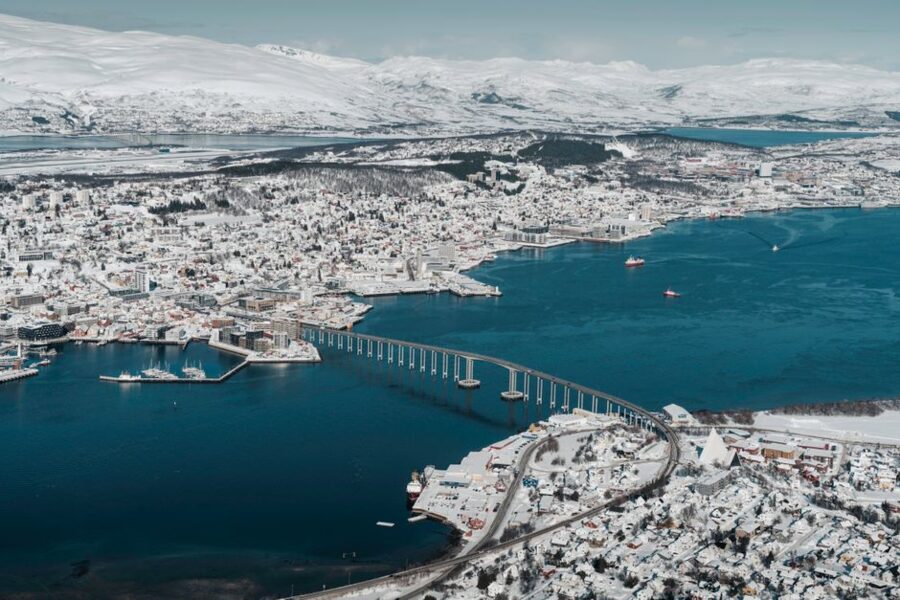
No train has ever reached Tromsø. The rails stop at Narvik, 232 km down the road, so this island city 350 km north of the Arctic Circle is reached by runway, by quay or by road, and almost every trip ends with the same short ride across Tromsøya into the centre.
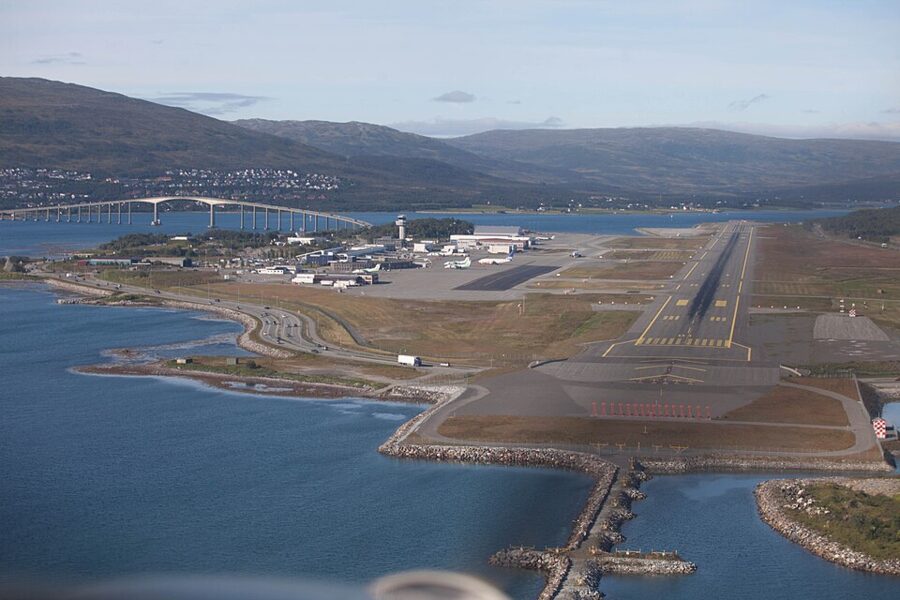
The runway does most of the work. On a Thursday in December fourteen flights leave Oslo for Tromsø, the first at 08:15 and the last at 21:50, and more than thirty airports elsewhere in Europe have direct flights filed for winter 2026-27. The quay is slower and more interesting: the northbound coastal ship from Bergen ties up in the middle of town at 14:15 on the fifth day of its voyage.

The road is the third way, and the hardest in winter. Everything else is a combination: a night train to Narvik and a bus north, a bus over the fells from Finland, a flight to Bodø and a ship. Times and fares are the ones the operators have published for the 2026-27 winter, and fares are for one adult, one way, unless I say otherwise.


Contents 8 parts
The short answer
Fly if you have a week or less. From most of Europe that means either a direct winter flight or a change in Oslo, and from the arrivals hall the airport bus has you in the centre twenty minutes later.
Take the coastal ship if the journey is part of the point and you can spare the days. Take the night train to Narvik and the bus if you want to arrive without flying, and drive only if you already know winter roads or are coming over the border from Finland, which is the easiest drive of the lot.
| Route | Time, start to Tromsø centre | Fare (adult, one way) |
|---|---|---|
| Fly Oslo to Tromsø | 2 hours in the air, about 3 hours terminal to town | Set by demand; see below |
| Direct flight from London, Frankfurt, Amsterdam and others | 3 to 4 hours in the air | Set by demand |
| Airport to the centre | About 20 minutes | NOK 125 Airport Express, NOK 50 city bus |
| Coastal ship Bergen to Tromsø | 3 days 17 hours 45 minutes | From NOK 5,992 with the compulsory cabin, no meals |
| Coastal ship Bodø to Tromsø | 23 hours | Deck tickets allowed on Hurtigruten |
| Express boat Harstad to Tromsø | 2 hours 45 minutes to 3 hours | NOK 630 |
| Night train Stockholm to Narvik, then bus | About 18 hours on the train plus 4 on the bus | Train set by demand; bus NOK 790 on the Arctic Route |
| Train and bus from Oslo via Trondheim and Fauske | About 35 hours with a short night in Narvik | Several tickets |
| Day bus Rovaniemi to Tromsø | About 9 and a half hours | About NOK 1,700 to 1,800; NOK 200 more over Christmas and New Year |
| Drive from Oslo | About 1,600 km and 26 hours at the wheel | Fuel, the Tysfjord ferry and tolls |
Flying to Tromsø
From Oslo and the rest of Norway
SAS and Norwegian share the Oslo route. On a weekday in December they fly it fourteen times in each direction, and the flight takes two hours. The last departure from Oslo, at 21:50, lands at 23:50, which still catches the late airport bus.
Widerøe, which has a base at Tromsø, flies most of the other domestic routes: Bergen up to three times a day (2 hours 5 minutes), Trondheim up to twice (1 hour 45 minutes), Bodø four times (55 minutes, with one more flight by SAS), and short hops from Alta, Hammerfest, Kirkenes, Leknes and Stokmarknes. SAS also flies to Longyearbyen on Svalbard, 1 hour 40 minutes each way.
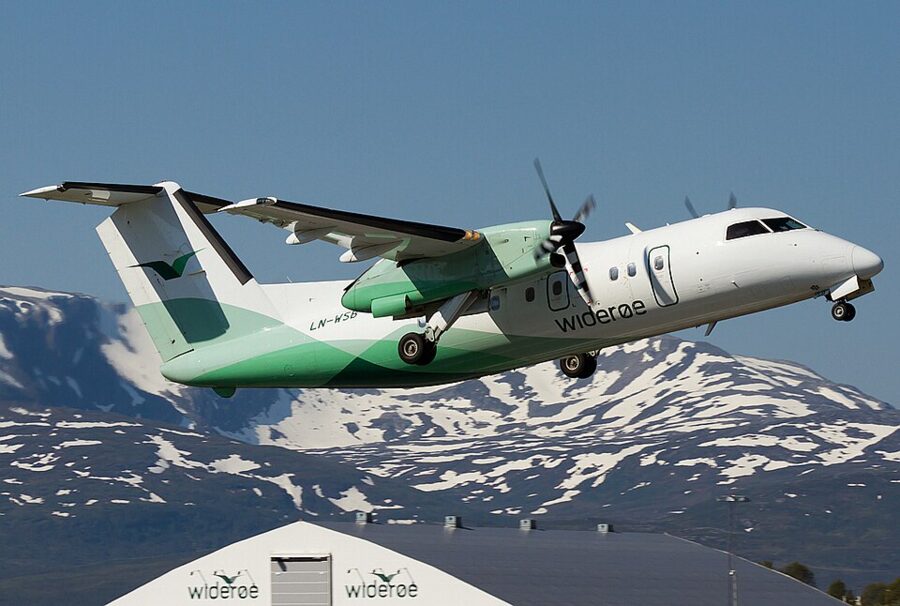

Fares on all three airlines are set by demand and change daily, so I won’t print one as if it were fixed. Book early for the weeks around Christmas and New Year, when Norwegians fly home and visitors fly in on the same planes.
Direct from Europe this winter
Tromsø is one of the easiest places in the Arctic to reach without changing planes. Avinor, which runs the airport, lists every route with flights filed for the coming six months, and the winter list is long. Almost all of these routes are seasonal: they start in late November or December and stop on 27 March 2027, the last day of the winter flying season.
| From | Airline(s) | Roughly how often in January |
|---|---|---|
| London Heathrow | British Airways | Daily (filed to 31 January) |
| London Gatwick | Norwegian, easyJet | 4 to 5 a week |
| London Luton | Wizz Air | 4 a week |
| Bristol, Edinburgh | easyJet | 2 a week each |
| Glasgow | Norwegian | 2 a week |
| Manchester | easyJet, Norwegian | Filed for March only so far |
| Dublin | Aer Lingus | 2 a week |
| Frankfurt | Lufthansa | Almost daily, into late April |
| Munich | Lufthansa, Norwegian | 4 a week |
| Berlin | easyJet, Eurowings, Norwegian | 4 to 5 a week |
| Düsseldorf, Hamburg, Stuttgart | Eurowings | 1 to 3 a week |
| Zürich | Edelweiss | Almost daily |
| Geneva | Norwegian | 2 a week, January to mid-March |
| Vienna | Austrian | 2 a week |
| Paris Charles de Gaulle | Air France, Norwegian, easyJet | Almost daily |
| Paris Orly | Transavia | Weekly |
| Amsterdam | Transavia | 3 to 4 a week |
| Milan Malpensa | easyJet, Wizz Air | 3 a week |
| Bergamo | Norwegian | 2 a week |
| Barcelona | Vueling | 2 a week |
| Belgrade | Air Serbia | 2 a week |
| Warsaw | LOT | 2 a week, to mid-February |
| Gdańsk | Wizz Air | 3 to 4 a week, into late April |
| Copenhagen | SAS, Norwegian | Daily |
| Stockholm Arlanda | SAS | 3 a week |
| Helsinki | Finnair, Norwegian | Daily |
| Rovaniemi | Finnair | Daily, into late April |
| Reykjavík Keflavík | Icelandair | 2 a week |
| Gran Canaria | Norwegian | Weekly |
Flying times run from 1 hour 10 minutes from Rovaniemi to just under four hours from Zürich, Paris and London Gatwick; Heathrow is 3 hours 40 minutes and Frankfurt 3 hours 35. Airlines add and drop routes through the season, so check Avinor’s list of direct routes from Tromsø before you plan around one, and treat a route that stops in January as a route that stops in January.

Changing planes in Oslo
If your airport isn’t on the list, you’ll change, usually in Oslo, Copenhagen, Stockholm or Helsinki. In Oslo the trick is to buy one ticket for the whole journey. Avinor’s Domestic Transfer, at gate D2, takes you from an international arrival straight to the domestic gates with your bags checked through, but only on a single through ticket, only for set airline pairs (SAS, Norwegian and Widerøe among them) and only between 07:00 and 23:00.
Miss any of those conditions and you collect your bags in the arrivals hall, go through customs, check in again and queue for security, which is not what you want to be doing with a 50-minute connection. The rules, and the full list of airline pairs, are on Oslo Airport’s transfer page.
From Tromsø Airport into town
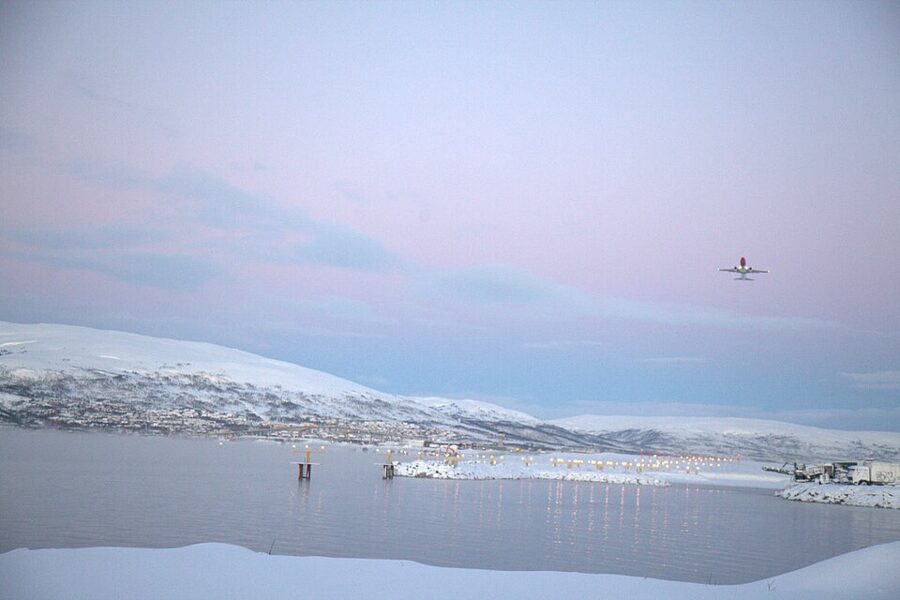
Tromsø lufthavn, Langnes, handled 2.68 million passengers in 2024, more than any other airport in Northern Norway. It sits about 3 km west of the centre on the same island, so the ride in is short whichever way you take it: around ten minutes by taxi, twenty by bus.

The Airport Express
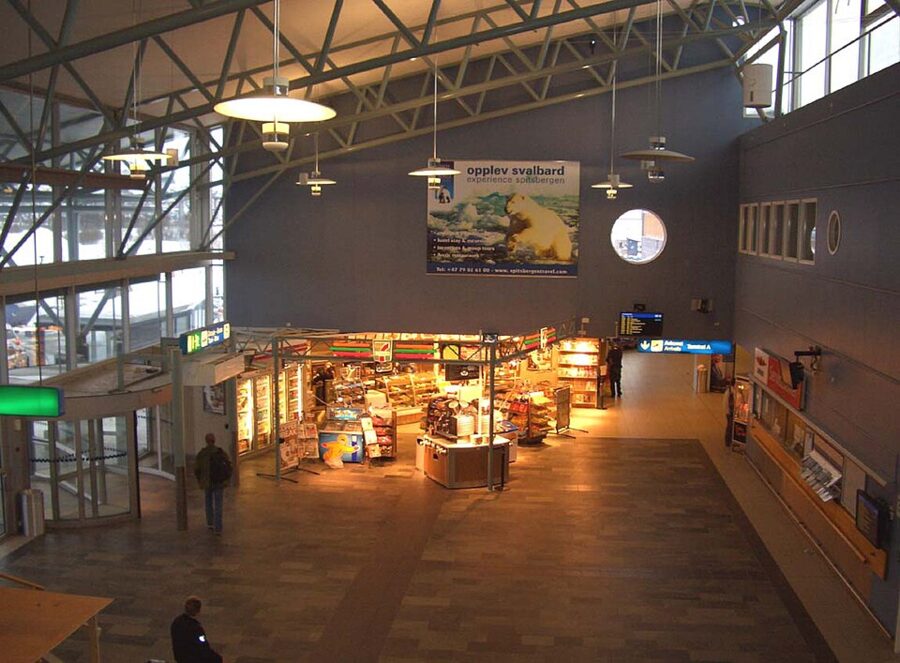
The red Airport Express bus waits outside the arrivals area. It is run by Bussring for Best Arctic, and its winter timetable, valid from 26 October 2026 to 31 March 2027, has 33 departures from the airport on a weekday, the first at 08:20 and the last at 00:20.
The ride takes about twenty minutes, stopping at Polaria, Storgata, the Prostneset bus terminal and the main city-centre hotels on the way. A single costs NOK 125 and a return NOK 200; children aged 4 to 15 pay NOK 80, and students and over-67s NOK 100. You can book online on the Airport Express page or pay the driver by card. The bus does not take cash.
City buses 40 and 42
The cheaper way in is the ordinary city bus. Lines 40 and 42 stop at the airport and run into the centre in about twenty minutes, and line 24 calls there too. They start soon after 05:00 and run until after midnight, which covers the early flights the Airport Express does not.
Svipper, the Troms public transport company, charges NOK 50 for an adult single within Tromsø, and NOK 30 off-peak, which in Tromsø means weekdays 09:00 to 14:00 and 17:00 to 01:00. Children and over-67s pay NOK 25. Buy in the Svipper app or from the ticket machine at the stop; the current bus fares have applied since 1 February 2026. With one suitcase this is fine; with skis and two cases I’d pay the extra for the Airport Express.


Taxi
The taxi rank is to the left as you leave arrivals, and the trip to the centre takes about ten minutes. You order at the Fast Travel kiosks by the arrivals exit: enter the destination, the luggage and the type of car, then scan the QR code to see the price before you agree to it.
Norway opened the taxi trade to more operators, and Avinor warns that prices vary between them. The driver must tell you the price before the trip starts, so ask if nobody does.
By sea: the coastal ships
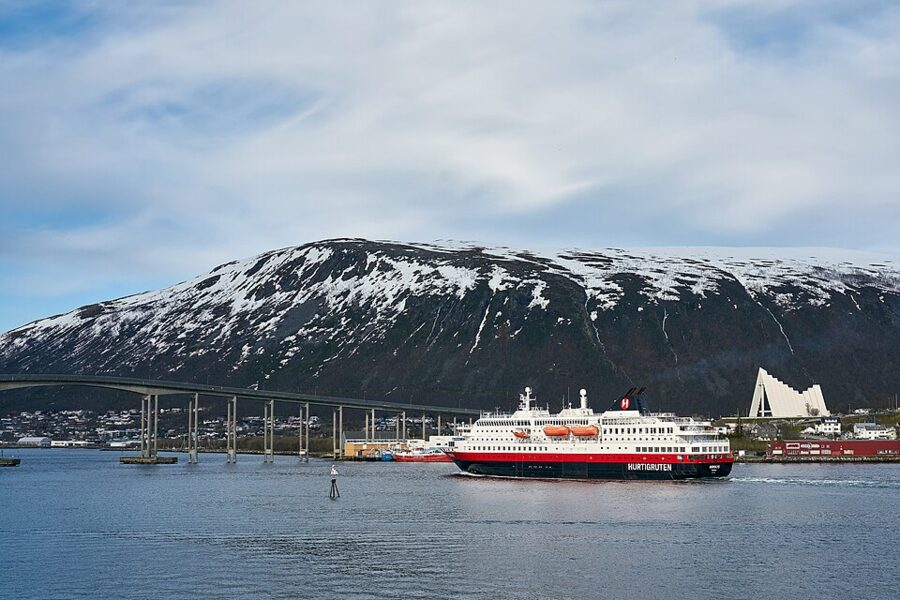
The Norwegian kystruten, the coastal route, began in 1893 between Trondheim and Hammerfest and now runs between Bergen and Kirkenes, calling at 34 ports. Two companies sail it, Hurtigruten and Havila Voyages, and between them there is normally a ship north and a ship south through Tromsø every day.
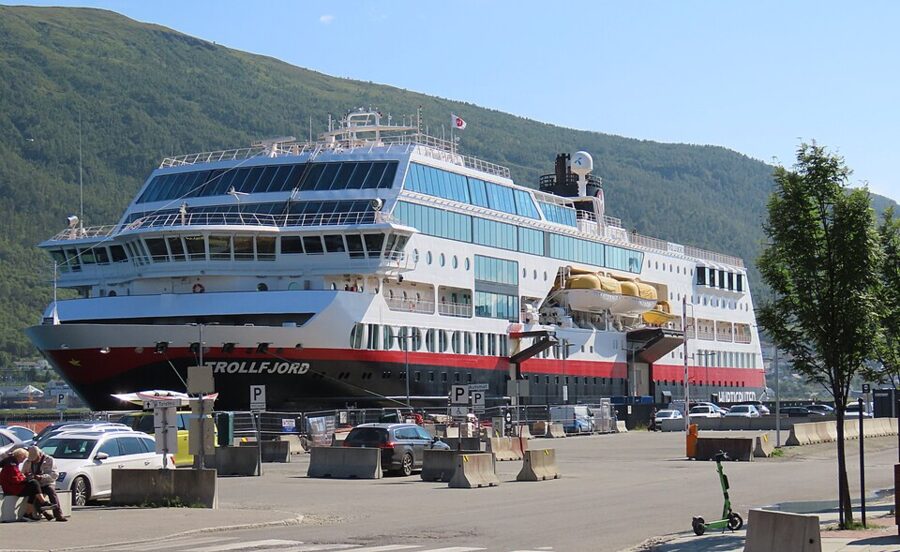

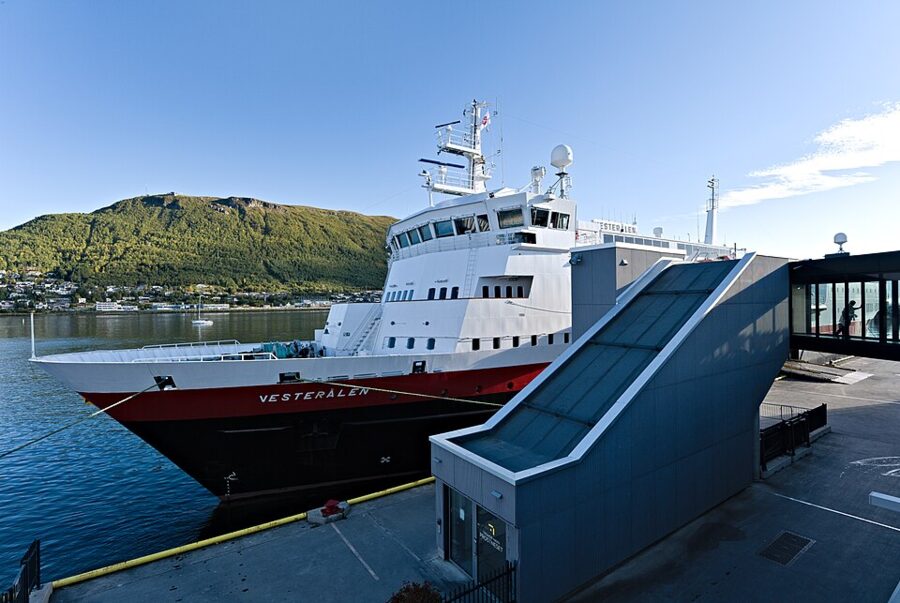
Both companies keep the same times at Tromsø. Northbound ships arrive at 14:15 and leave at 18:15; southbound ships arrive at 23:45 and leave at 01:30. They berth at Prostneset, the harbour terminal in the centre, so you walk off the gangway into town, a few minutes from most hotels.
From Bergen, the ship leaves at 20:30 on day one, spends day two around Ålesund, reaches Trondheim on the morning of day three, crosses the Arctic Circle and calls at Bodø on day four, threads through Lofoten that evening and reaches Harstad, Finnsnes and finally Tromsø on day five. That is 3 days, 17 hours and 45 minutes. In winter much of the scenery passes in the dark, which is the main argument against doing the whole thing in December.
Fares, cabins and deck
A port-to-port ticket is transport, not a cruise: no meals are included, though you can add meal packages when you book or pay on board. On Hurtigruten you need no cabin for a journey under 23 hours, but anything longer requires one, and the cheapest Bergen to Tromsø fare on Hurtigruten’s port-to-port page is NOK 5,992. Trondheim to Tromsø is listed from NOK 2,840 on offer, NOK 3,550 normally.
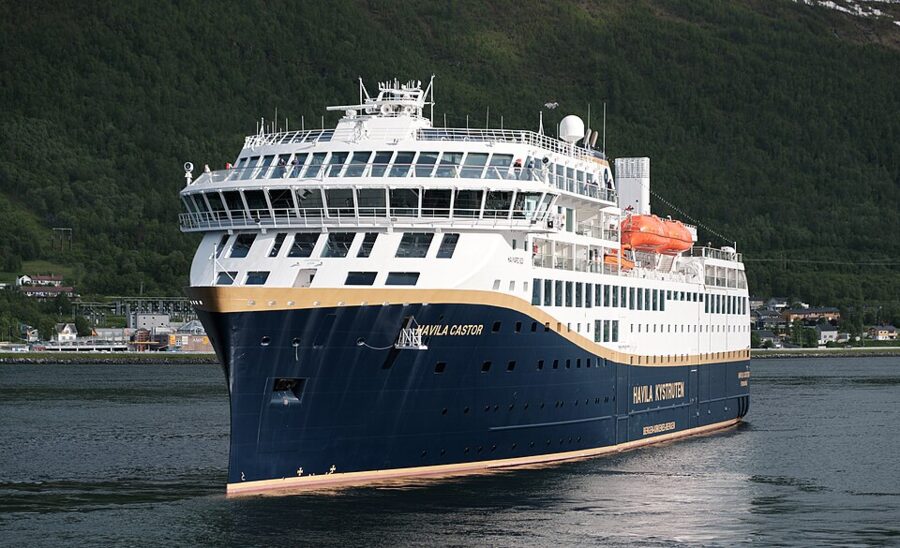
Children up to five travel free on Hurtigruten and those aged 6 to 17 get 75 per cent off the ticket, though not the cabin. Deck passengers can use the saunas, hot tubs and lectures like everyone else. Havila sells the same kind of trip with a choice of a deckchair or a cabin overnight; its port-to-port tickets must be booked at least two hours before the ship reaches your port, and no earlier than six months ahead.
Check the ship before you book in early December. Hurtigruten’s Richard With is out of service until 10 December 2026 after a longer shipyard stay, with all its calls cancelled, and Havila Capella only returns on 1 December. Havila Castor is out again from 27 March to 28 April 2027, according to the Havila sailing schedule.

Joining in Bodø or Lofoten
The best value on the route is the last day. Northbound ships leave Bodø at 15:20 and reach Tromsø at 14:15 the next day, 23 hours with Stamsund, Svolvær, Stokmarknes, Sortland, Risøyhamn, Harstad and Finnsnes in between. That is under Hurtigruten’s 23-hour limit, so a deck ticket is allowed, though I would still take a cabin for the night.
Svolvær, in Lofoten, is 16 hours from Tromsø by the same ship, leaving at 22:15. If Lofoten is your next stop rather than your last, the same ships, flights and buses run the other way, from Tromsø to Lofoten.
Express boats from Harstad and Finnsnes
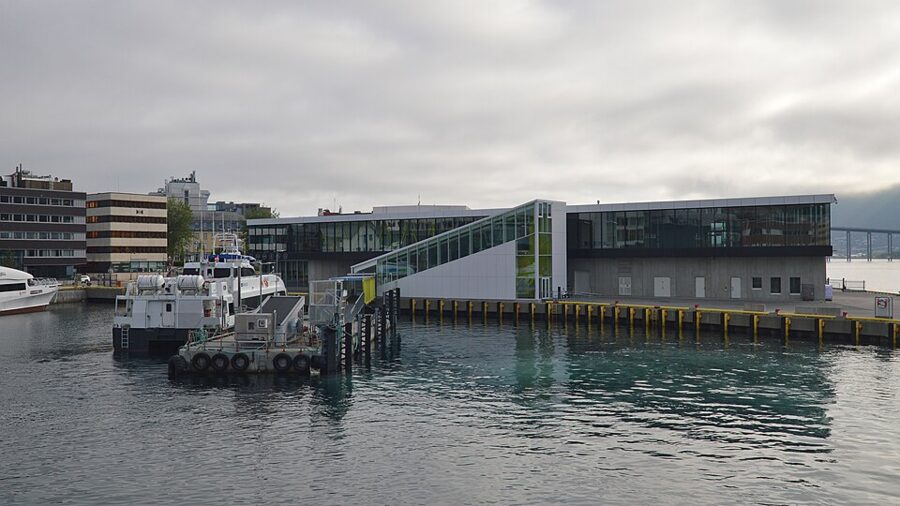
Svipper’s line 2, run by Norled, is the express boat between Harstad, Finnsnes and Tromsø. On a weekday in December it leaves Harstad at 07:00, 13:00, 17:00 and 19:30, takes 2 hours 45 minutes to 3 hours, and docks at the express-boat quay at Prostneset. Departures from Tromsø go at 07:00, 13:45, 16:15 and 20:30.
The express-boat fare tables put Harstad to Tromsø at NOK 630 for an adult and Finnsnes to Tromsø at NOK 295, with Saturday tickets far cheaper at NOK 277 and NOK 128. Since 1 February 2026 every Troms express boat has guaranteed seats, which means you must buy a ticket for a specific departure in advance rather than pay on board.

Finnsnes is the town at the bridge to Senja, Norway’s second-largest island, so the boat is also the quickest public way from Senja to Tromsø. In winter Best Arctic also runs a daily bus between Tromsø and Senja from 15 December to 31 March, from NOK 750.
Overland: the train gets you close
There is no train from Oslo to Narvik inside Norway. Narvik’s railway, the Ofotbanen, runs only east, 43 km up the mountainside to the Swedish border at Riksgränsen, where it joins the Swedish line through Kiruna. So the rail route to Tromsø starts in Stockholm, or in Oslo with a long detour north through Trondheim to Fauske and Bodø.
Stockholm to Narvik on the night train
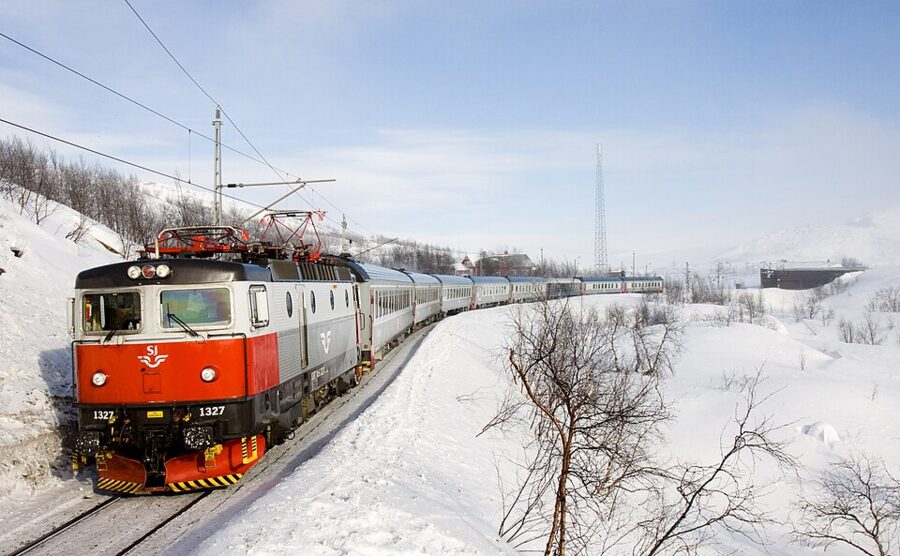
SJ runs two departures a day from Stockholm to Narvik on its night trains, and the journey takes about 18 hours. You can book a sleeping compartment with a made-up bed, a couchette or a plain seat. Prices move with demand, as they do on the planes, and you book on SJ’s Stockholm to Narvik page.
The connection timetable Best Arctic publishes for this winter has the train leaving Stockholm at 18:10, reaching Kiruna at 09:29 and Narvik at 12:35. Going south, it leaves Narvik at 15:11, reaches Kiruna at 17:54 and arrives in Stockholm at 09:26 the next morning. I’d take the sleeper: the cheapest seat is cheap for a reason after Boden.
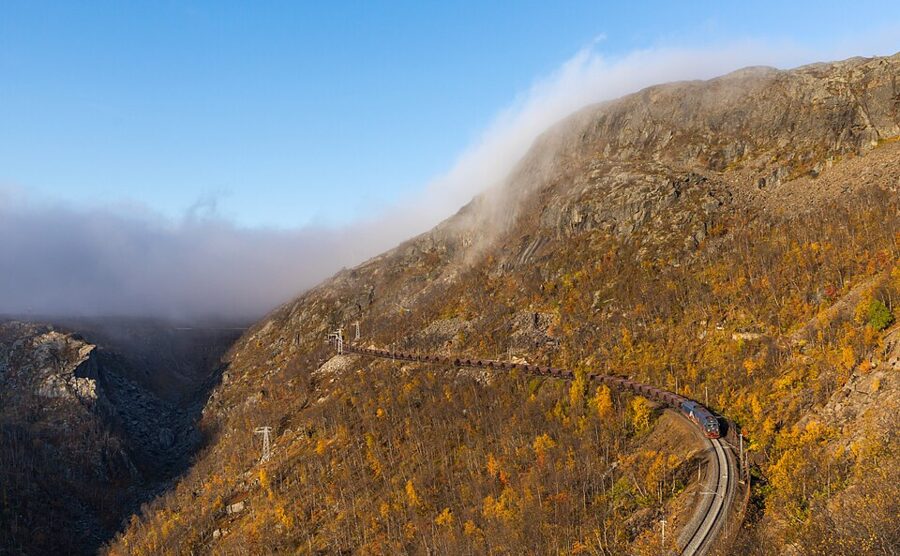

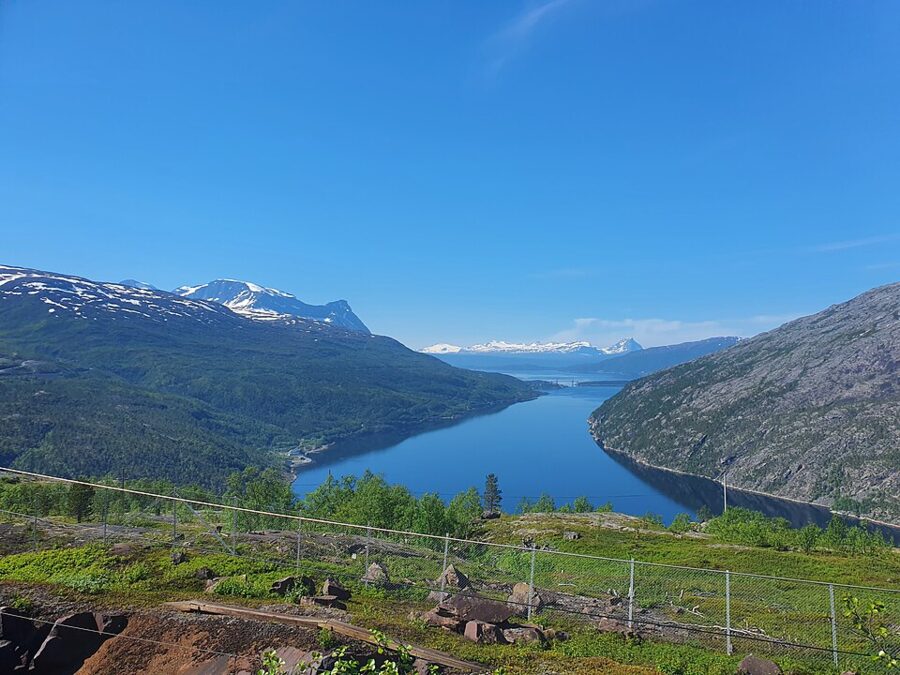
The last stretch is the reason to come this way. After the border the line drops through 20 tunnels and along the side of the Rombaksfjord, high above the water, and the passenger trains share it with the ore trains that are the line’s real business. In daylight it is one of the great short train rides in Europe; in the December dark, it is a lit carriage and the sound of the tunnels.

Narvik to Tromsø by bus
Two bus services cover the last 232 km. The year-round one is Svipper’s line 100, run by Tide, which leaves from Bromsgård, a few minutes’ walk from Narvik station. On a December weekday it goes at 05:37, 13:03 and 15:48 and reaches the Prostneset terminal at 09:30, 17:25 and 19:50, a little under four hours to a little under four and a half.
In the other direction it leaves Tromsø for Narvik at 06:20, 10:30 and 16:00. Buy the ticket in the Svipper app.
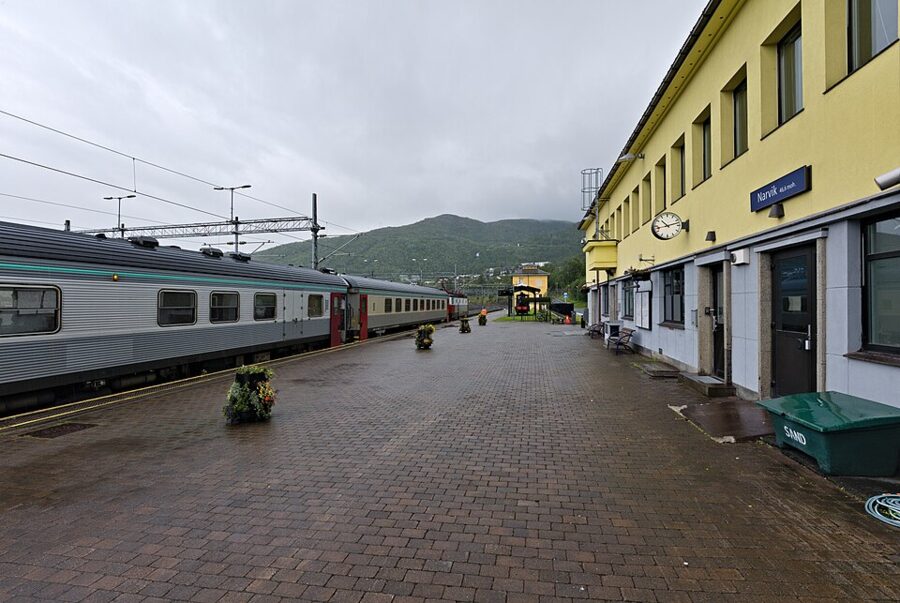
From 1 December to 31 March the Arctic Route bus, run by Bussring for Best Arctic, adds a daily departure timed to the train: 14:00 from Narvik station to Tromsø at 18:00, and 09:00 from Tromsø to Narvik at 12:45, in time for the 15:11 train south. The full trip costs NOK 790 on the Narvik bus page, the coaches have Wi-Fi and a toilet, and it stops at Polar Park, the wildlife park on the way, if you want to break the trip there.
Oslo, Trondheim and the Nordland Line
From Oslo the rail route north stays in Norway but stops short at Bodø, and SJ Nord runs both legs. On a typical December day the night train leaves Oslo S at 22:50 and reaches Trondheim at 06:40; the Nordland Line train leaves Trondheim at 07:49 and reaches Fauske at 16:45 and Bodø at 17:38, after crossing the Arctic Circle on the Saltfjellet plateau.
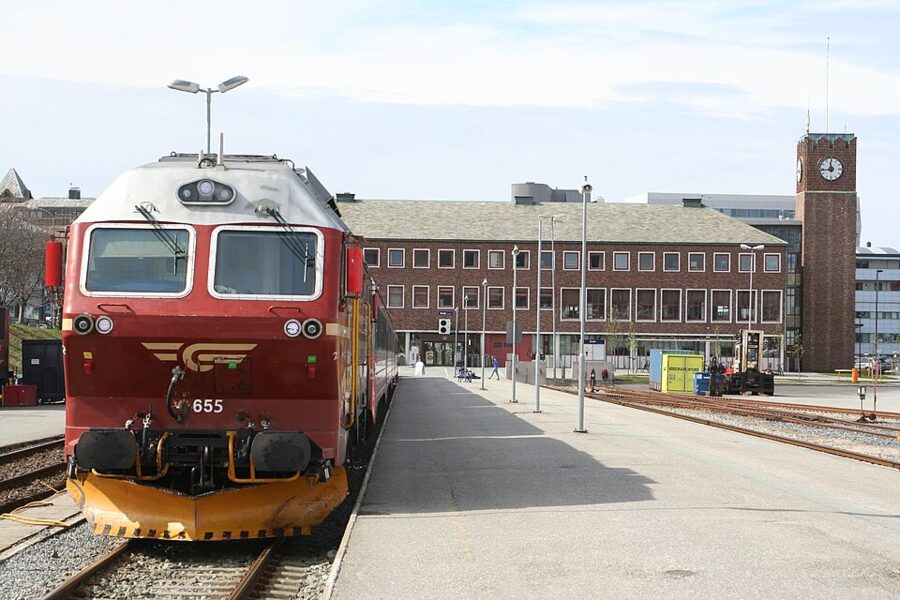

From Fauske, Nordlandsbuss runs its own line 100 to Narvik. The 18:00 departure, an hour and a quarter after the train gets in, changes buses at Storjord and reaches Narvik at 23:15. After a short night you take Svipper’s line 100 at 05:37 from Bromsgård and you are in Tromsø at 09:30, about 35 hours after leaving Oslo. If you’d rather sleep in Fauske, the 08:35 bus reaches Narvik at 13:41 and connects with the Arctic Route at 14:05, into Tromsø at 18:00.
Or stay on the train to Bodø and finish by sea: overnight in Bodø, then the coastal ship at 15:20 the next day and Tromsø at 14:15 the day after. It is slower, but it is the version of this trip I would choose.

Driving to Tromsø
Routes and distances
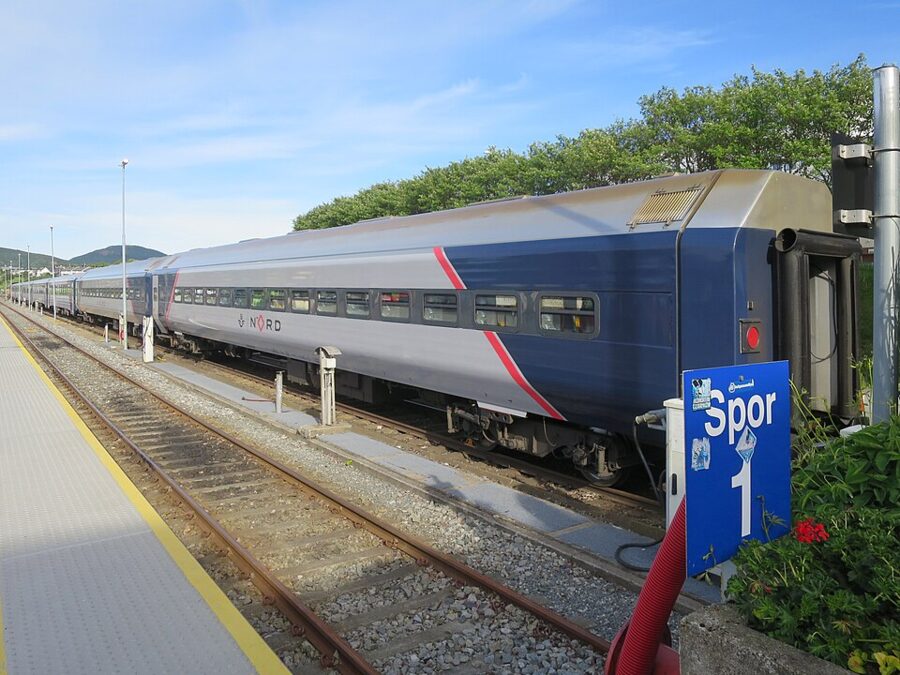
From Oslo, the E6 runs the whole length of the country, about 1,600 km and around 26 hours of driving by the route planners, not counting stops for sleep, fuel or weather. Between Fauske and Narvik it crosses Tysfjorden by ferry from Bognes to Skarberget; Fjord1 runs the crossing every hour or so by day and several times through the night. North of Narvik the E6 goes on to Nordkjosbotn, where the E8 branches off for the last 71 km to Tromsø.
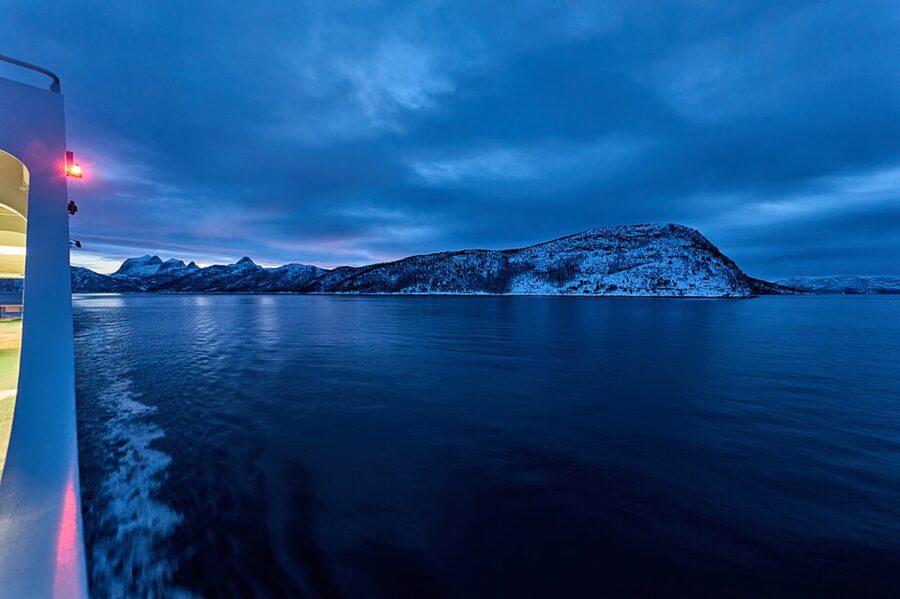
Route planners also find a line up through Sweden and Finland that crosses back into Norway at Kilpisjärvi. It is about 140 km longer and no faster, and only makes sense if you want Sweden and Finland on the way. Realistically, either is a three-day drive in winter.
From Narvik it is 232 km, about four hours. From Finland the E8 leaves Kilpisjärvi, crosses the border plateau, passes Helligskogen and drops down Skibotndalen to the E6 at Skibotn, 49 km in all; from there the E6 runs south along the fjord to Nordkjosbotn, where the E8 takes over again. Kilpisjärvi to Tromsø is 161 km, about two and a half hours; Rovaniemi to Tromsø is about 600 km, around nine.
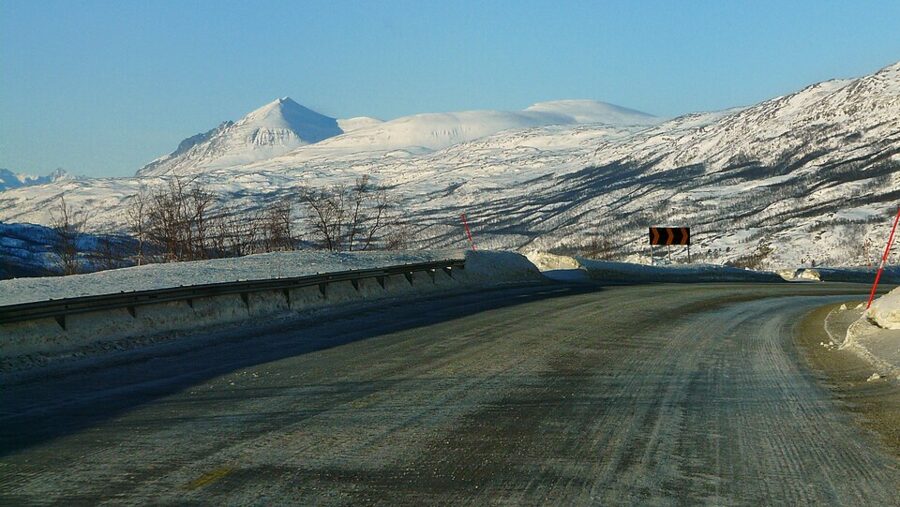

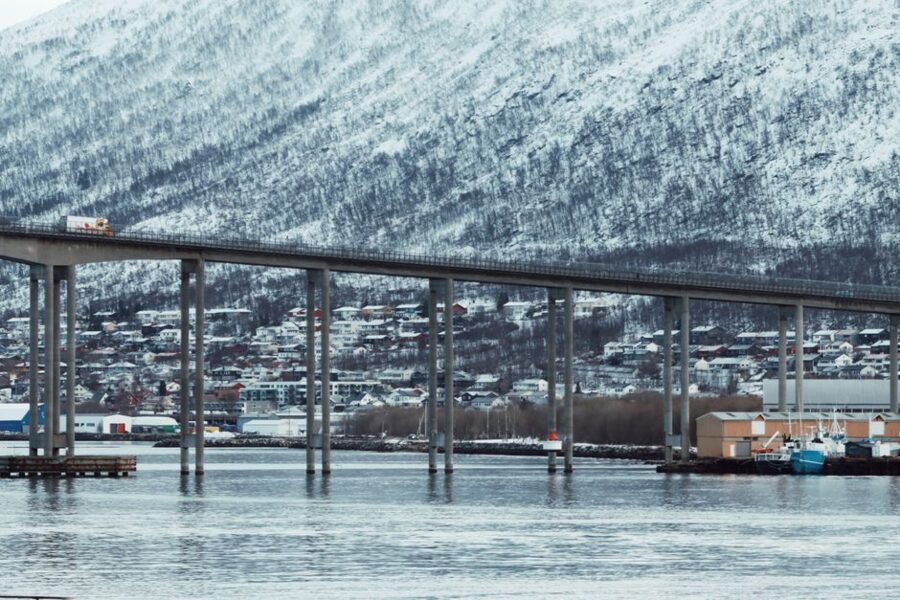
The E8 reaches Tromsøya through the Tromsøysund tunnel, opened in 1994. The older Tromsø Bridge, opened in 1960 and now a protected monument, carries county road 862 over the sound next to it, and from Kvaløya the Sandnessund Bridge brings you in past the airport.
Winter rules
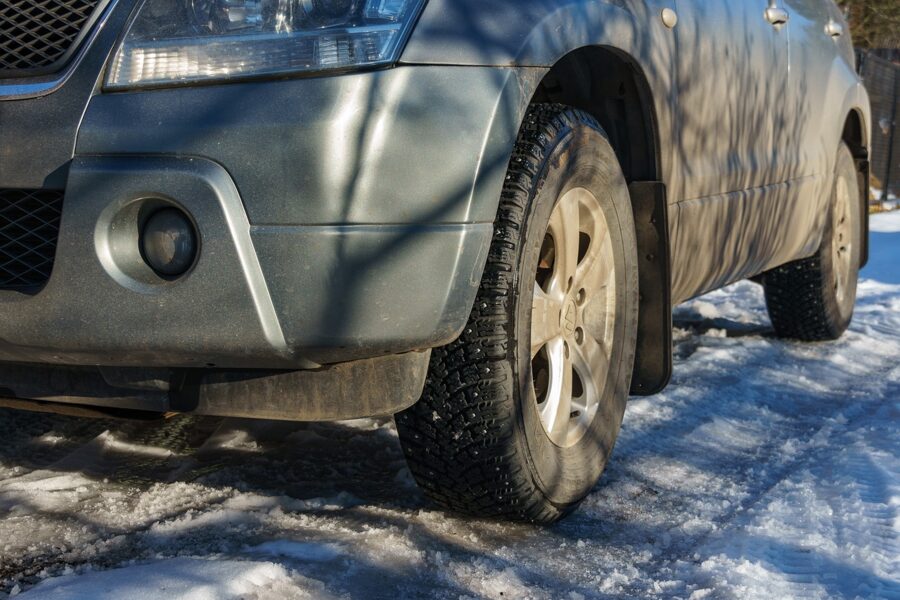
There is no single date by which a car must wear winter tyres. The rule is that you are responsible for enough grip, and summer tyres do not grip on ice and snow. What the law does fix is tread depth: in Nordland, Troms and Finnmark your tyres must have at least 3 mm from 16 October to 30 April, against 1.6 mm in summer, according to the Statens vegvesen tyre requirements.
Studded tyres, piggdekk, are allowed in the three northern counties over the same period, 16 October to 30 April, and outside it when conditions demand. If you use them, they go on all four wheels. Non-studded winter tyres are allowed all year.
Mountain crossings in bad weather run in kolonnekjøring, convoy, behind an escort vehicle. The rules are simple: follow the signs and the traffic controllers, never overtake or turn round, keep the rear lights of the car ahead in sight, and stay in the car if the convoy stops. If the road is closed, it is closed.
Statens vegvesen’s advice on driving on winter roads reads like a packing list for a reason: shovel, warm clothes, food, a torch, a tow rope, a blanket, jump leads, and a full tank or a full battery before any mountain pass. Check the road reports before you set off and again before the border. Remember the dark too. Between 28 November and 14 January the sun does not rise in Tromsø, and from November to January most of a day’s driving happens under headlights.
Tolls, ferries and charging
Tromsø has had a toll ring since 5 January 2023: 15 toll points around the city, charged in both directions, with a one-hour rule so you pay for only one passage in any hour. Rates triple on weekdays from 06:30 to 09:00 and from 15:00 to 17:00. Without an AutoPASS tag you pay full price, invoiced to the vehicle’s owner, so ask your hire company how it passes the charges on; the details are on the Tenk Tromsø toll page.
Electric cars with a tag paid 40 per cent of the full toll until 30 June 2026; since then they pay 56 per cent. The cold cuts an electric car’s range and the distances between towns are long, so charge before the climb: I would never start up Skibotndalen with less than half a battery.
From Finland and Sweden
By bus from Rovaniemi, Levi and Kilpisjärvi
From 20 November 2026 to 31 March 2027 a daily bus links Tromsø and Rovaniemi, sold by Best Arctic as the Arctic Route and run jointly with Eskelisen Lapin Linjat, the Lapland bus company. You change buses at Kilpisjärvi, at the K-Market by the petrol station: Best Arctic’s red coaches cover the Norwegian end, Eskelisen’s yellow and red ones the Finnish.
Southbound it leaves Prostneset at 07:00, reaches Kilpisjärvi at 10:30 Finnish time, stops for half an hour at Karesuvanto, and continues by Muonio, Levi and Kittilä airport to Rovaniemi railway station at 17:20. Coming the other way it leaves Rovaniemi bus station at 11:40 (11:20 from the railway station) and reaches Tromsø at 19:45. Finland is an hour ahead of Norway, so the clock makes the northbound trip look shorter than it is.
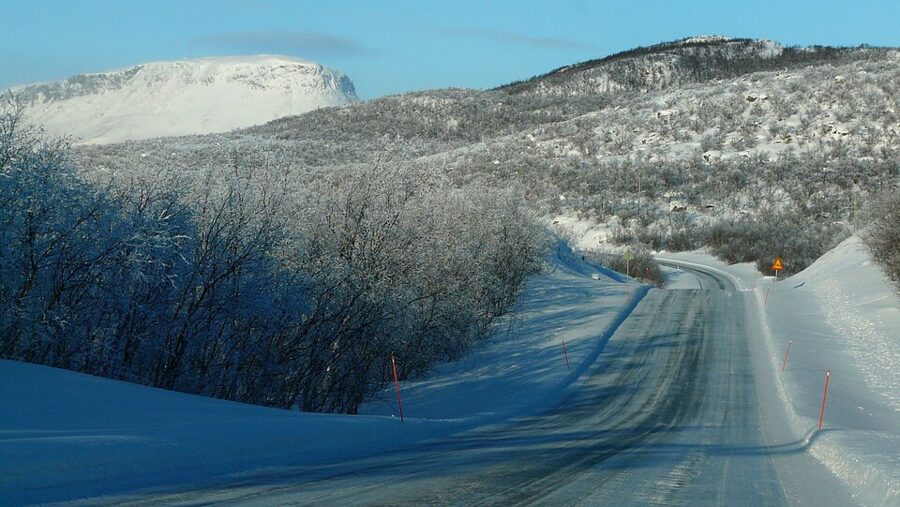

The full run costs NOK 1,690 to Rovaniemi and NOK 1,790 from the Santa Claus Village stop back to Tromsø, NOK 200 more between 21 December and 5 January, on the Tromsø to Rovaniemi bus page; shorter stretches cost less, from NOK 475. Over New Year you may have to stand on the Finnish leg: Best Arctic says Finnish rules let the bus carry 30 per cent more passengers than seats, and it refunds the stretch you stood for. Tickets on the Finnish side are also sold through Eskelisen, online or on board with cash or card.
The bus is the natural link if you are pairing Tromsø with a cabin holiday in Finnish Lapland, since Kilpisjärvi, Muonio and Levi are all stops. It also meets the train: Eskelisen times the Rovaniemi pick-up for the VR night train from Helsinki, which arrives at about 11:00.
For the night instead of the day, the Aurora Express runs from 7 December to 31 March. It leaves Tromsø at 20:50 and reaches Rovaniemi at 07:45; going north it leaves Rovaniemi at 23:00 and reaches Tromsø at 07:45. It is a double-decker with semi-reclining seats and a snack box, breakfast is served on arrival in Finland, and it stops for the northern lights if they show.
The night bus costs NOK 3,000 to 3,850, and children must be at least four. In summer the day bus runs again from 12 June to 20 September.


Flying from Helsinki and Rovaniemi
Finnair flies to Tromsø from Helsinki daily (1 hour 50 minutes), with some Norwegian flights as well, and daily from Rovaniemi in 1 hour 10 minutes, through to late April. That Rovaniemi flight turns a ten-hour bus ride into a morning. Nothing is filed this winter from Kittilä or Ivalo.
From Swedish Lapland
From Kiruna or Abisko the obvious route is the train to Narvik and one of the buses north; Abisko is on the same line as the Stockholm night train. If the train doesn’t suit, Best Arctic runs a Kiruna to Narvik bus all year, 3 hours 15 minutes for NOK 789.
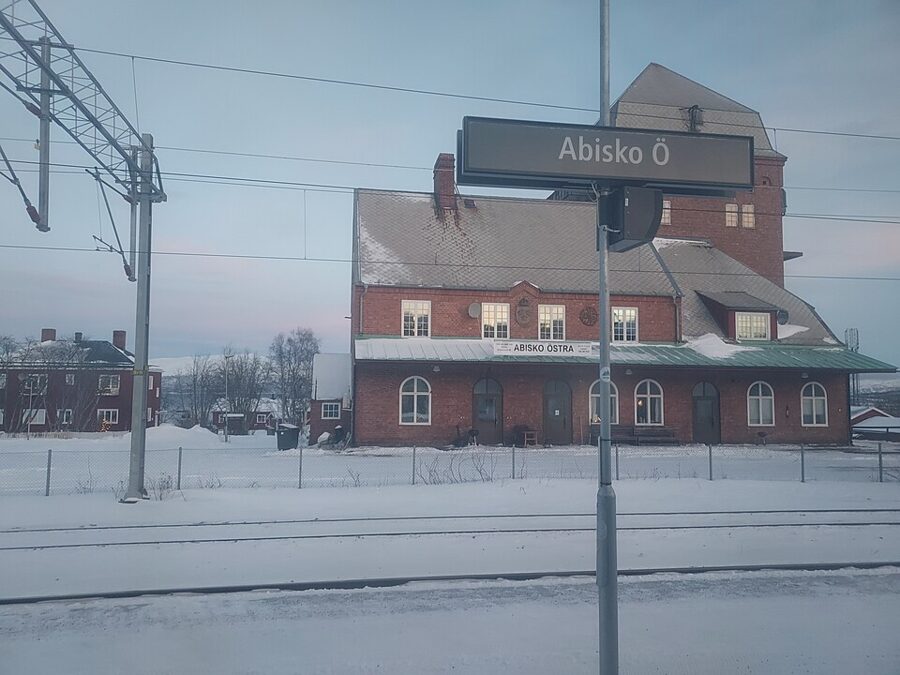

By car, Kiruna to Tromsø is about 390 km. From Stockholm, SAS flies direct to Tromsø about three times a week in 2 hours 5 minutes, and Copenhagen has daily flights on SAS and Norwegian.
Which way suits you
For a week or less, fly. Choose a direct flight if your city has one, and if not, take a through ticket via Oslo so Domestic Transfer works. Then the Airport Express or the 40 or 42 into town.
If the journey matters as much as the place, take the ship. From Bodø it is a day and a night with Lofoten in the middle; from Trondheim it is two nights; the full voyage from Bergen I’d keep for March, when there is light to see it by.
If you would rather not fly, take the night train from Stockholm to Narvik and the bus north. It is the simplest overland route, and the bus connections are built around the train. The Nordland Line from Oslo works too, but it means two trains, a bus, a ferry and a night somewhere in between.
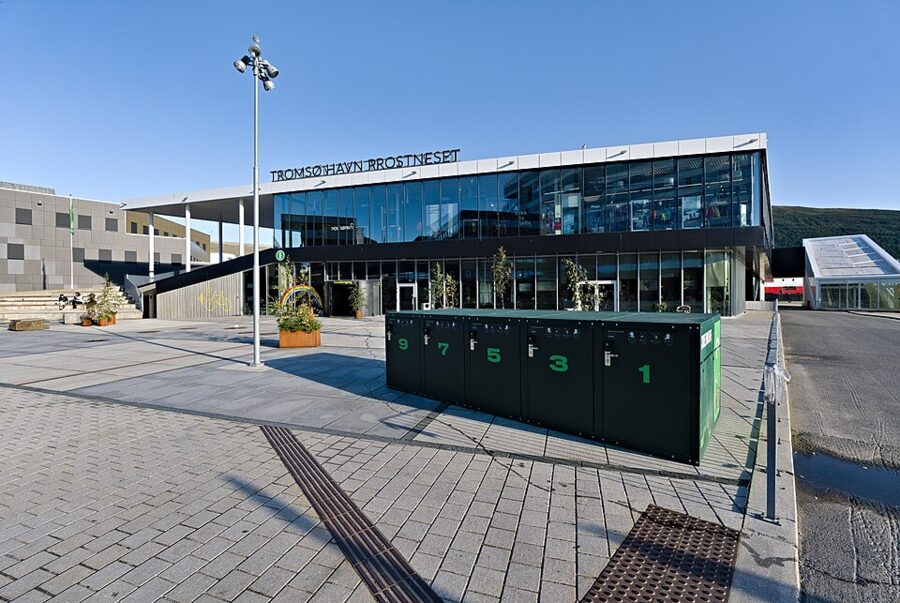
Drive only if you are comfortable on snow, or if you are coming from Finland, where the E8 from Kilpisjärvi is the shortest and simplest road in. Coming the full length of Norway in winter is an expedition, and in my view the better plan is to fly in and hire a car in Tromsø if you need one.
The train still stops at Narvik. But arrive on the night train at 12:35, walk round to Bromsgård for the 13:03 bus, and you reach the quay at Prostneset at 17:25, with the northbound ship still tied up alongside until 18:15.