


In Karasjok the sun goes down on 28 November 2026 and does not come up again until 14 January 2027. Christmas Eve falls in the middle of that run of sunless days, and for generations of Sámi children in Finnmark it was not the best night of the year. “Christmas Eve was the most dangerous day of the year,” Odd Mathis Hætta, a former associate professor of Sámi culture and language, told NRK in December 2023.

The danger had a name. Juovlastállu, the Christmas stállu, came through the yard on Christmas Eve on a sledge drawn by mice or lemmings. If the yard was cluttered, his sledge stuck. If there was no water set out for him, he found something else to drink.
Most Sámi families today keep Christmas much as their Norwegian, Swedish and Finnish neighbours do. The Centre for Sámi Studies at UiT, writing on its Reaidu site about Sámi Christmas traditions, is blunt about it: plenty of Sámi homes eat pork ribs or pinnekjøtt (salted, dried lamb ribs) on Christmas Eve, decorate a tree and watch the same television as everyone else. Some make their pinnekjøtt from reindeer, and some put on a gákti, the Sámi dress, for church.
The differences sit underneath: the old stories of the dark season, a church shaped by one of the strictest revivals in the Nordic countries, and a working calendar set by reindeer rather than shops.

Contents 8 parts
- 01Skábma, juovllat and juovlaruohta: the words for the dark
- 02Juovlastállu, the visitor nobody wanted
- 03Before the church: gifts for the midwinter powers
- 04Læstadius and the plain Christmas
- 05Christmas Eve in Kautokeino and Karasjok
- 06Reindeer, trout and biđos: the Christmas table
- 07December in the herd
- 08Where to meet Sámi midwinter culture in December and January
Skábma, juovllat and juovlaruohta: the words for the dark
North Sámi has a word for the dark time of year: skábma, the late autumn and early winter. Store norske leksikon gives skábmamánnu, “the dark-time month”, as the Sámi name for November. December is juovlamánnu in North Sámi, javllamánno in Lule Sámi and jåvleaske in South Sámi: in all three, the Christmas month.
The word for Christmas itself, juovllat, is old and borrowed. It came into Sámi from the Scandinavian languages, from the same root as Old Norse jól and the Norwegian jul. Christmas Eve is juovlaruohta, and New Year’s Eve is ođđajagiruohta; you will see both on church notices in Karasjok and Kautokeino in December. “Merry Christmas” is buorit juovllat in North Sámi, buorre javlla in Lule Sámi and læhkoe jåvhl in South Sámi.
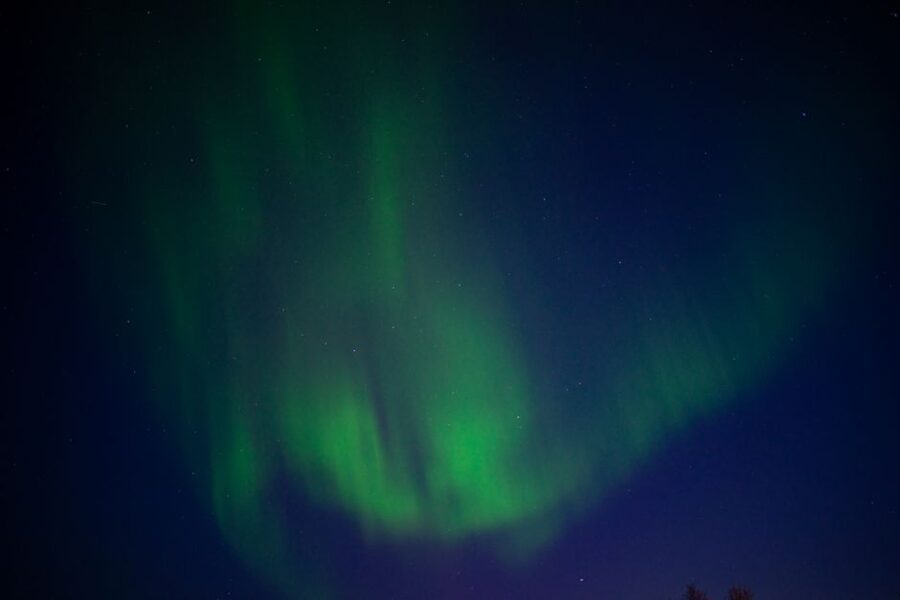
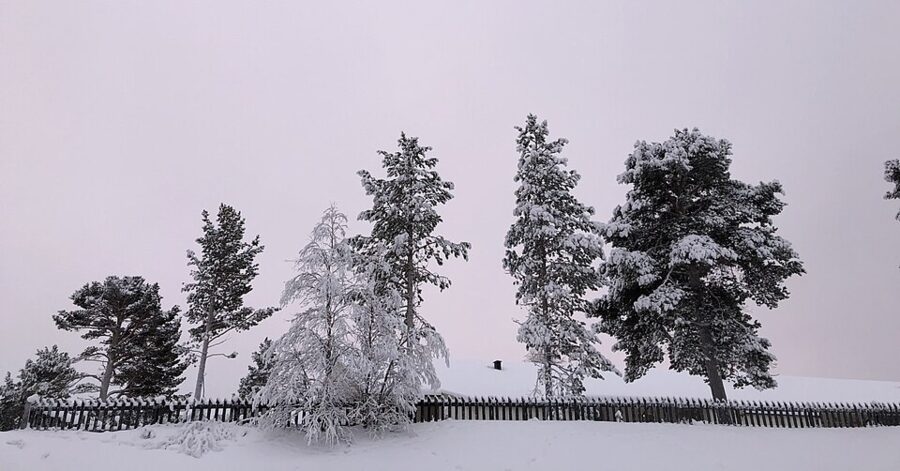
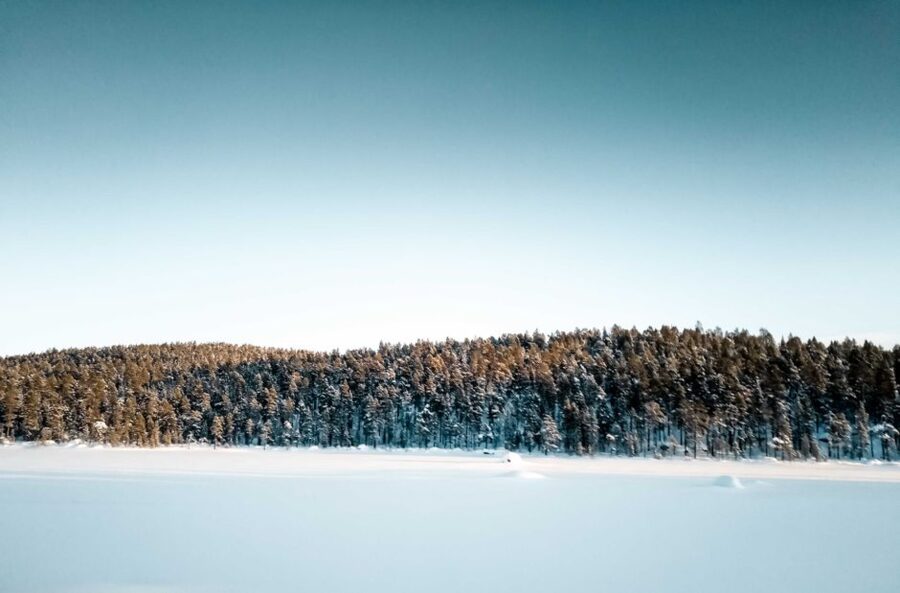
How dark is the dark? By the Norwegian Meteorological Institute’s sunrise data for the 2026-27 winter, the sun stays below the horizon in Karasjok from 29 November to 13 January, in Kautokeino from 1 December to 10 January, and in Inari in Finland from 2 December to 10 January. Jokkmokk, just north of the Arctic Circle in Sweden, keeps a sliver of sun on the shortest day.
The year of Sámi reindeer herding has eight seasons, not four, and December sits where čakčadálvi, autumn-winter, turns into dálvi, winter.
Juovlastállu, the visitor nobody wanted
Stállu is the giant of Sámi storytelling: big, man-shaped, cruel and fortunately stupid. Store norske leksikon’s entry on stallo, written with the Reaidu team, describes him eating people, children especially, travelling with a dog called Rakke and carrying a silver treasure that passes to whoever beats him. His wife, Luhtak, sucks the life out of people through an iron pipe; in some stories he carries the pipe himself.
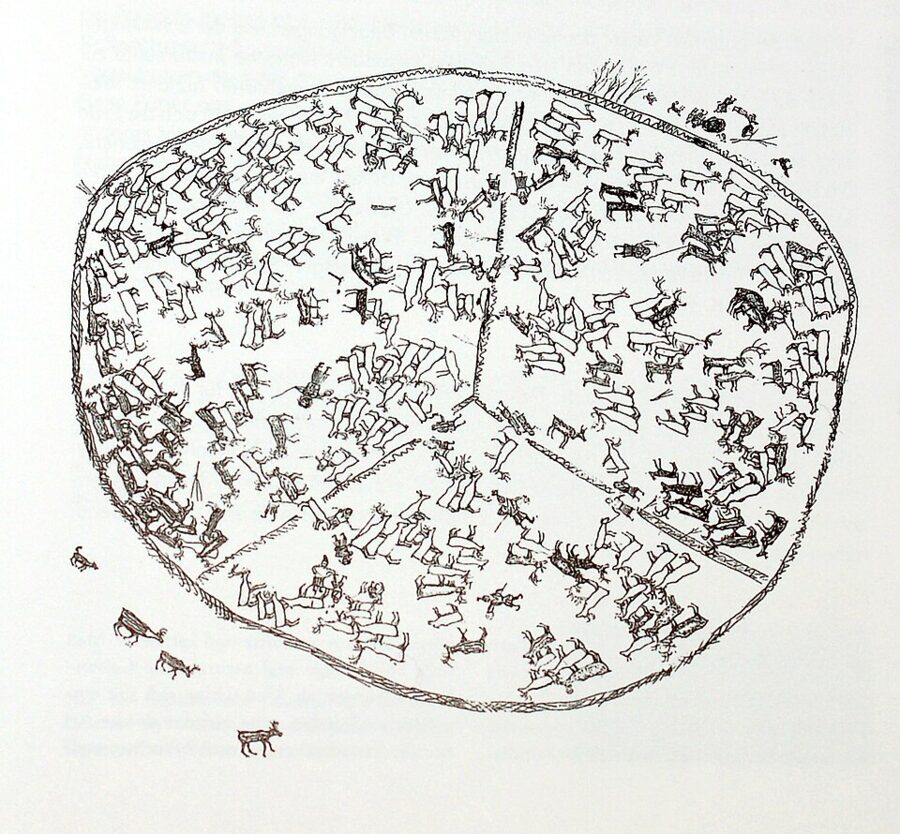
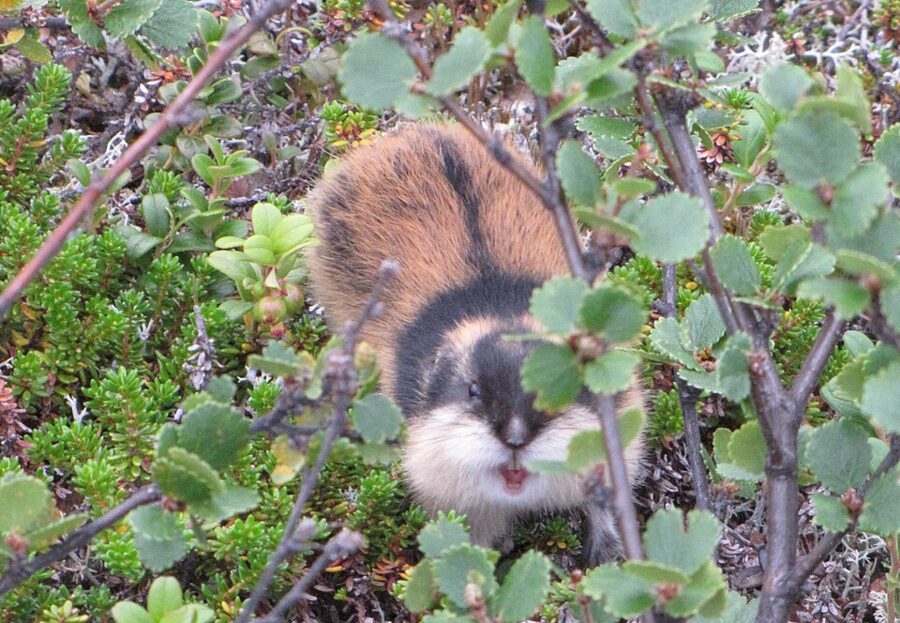
The Christmas version is a specialist. In the juovlastállu stories he arrives on Christmas Eve driving a ráidu, a caravan of sledges, pulled not by reindeer but by mice or lemmings. Hætta told NRK that the animals in the caravan could also be stoats, foxes, wolves and bears. He came, the stories say, because people were meant to keep the Christmas holy days quiet and still, and he punished those who did not.
Store norske leksikon traces stállu back to real people: Norse and Russian warriors, raiders and tax collectors who came north in mail shirts. The word itself may come from stål, steel. It gives the Christmas visitor a dry logic: a man from outside who turns up in midwinter and expects to be provided for.

Water by the door and a tidy yard
The rules were practical, and they all pointed at the same hour. Reaidu lists them: the housework, the sewing and the woodcutting had to be finished by the forenoon of Christmas Eve at the latest. The yard round the house had to be cleared so the caravan would not catch on anything. And water had to be put out so juovlastállu could quench his thirst.
Margrethe Vars from Karasjok told NRK that children had a particular job: the yard was theirs to clear. “The children who did not tidy up might have to go out and free stállu’s sledge if it got stuck,” she said. Her generation also could not go sledging on the Christmas holy days, for fear of ending up in his sack.
The silence rule is the one that has lasted longest in family memory. Reaidu puts it plainly: children were not to make much noise at Christmas, and anyone who went skiing or sledging on Christmas Eve or Christmas Day might find juovlastállu waiting at the bottom of the slope with his sack open. Nils Henrik Sara, founder of a Sámi culture centre in Alta, told Visit Alta about testing the rule at six or seven with a friend. On Christmas Eve they went sledging anyway, made as much noise as they could and shot down a slope towards the river ice, straight into a sack.
The sack belonged to a neighbour’s wife who had decided to teach two loud boys a lesson. He never sledged on Christmas Eve again. That is the system working as designed.
Blood or brains: where the stories differ
The sources agree on the water and the tidy yard, and split on the penalty. Store norske leksikon and Reaidu say that a juovlastállu who found no water would drink the blood of the people in the house; other North Sámi tellings have him suck out someone’s brains. Hætta told NRK both were true, in different places: in some districts the children’s blood, in others the youngest child’s brain.
There is a further split over gifts. In some later tellings stállu turns into a version of the Christmas man who brings presents, and today juovlastállu is also simply the North Sámi word for Father Christmas. The singer Elin Kåven, whose 2015 song “Stálu Fápmu” (“Stállu’s power”) is a Christmas song about him, put the older figure more sharply to NRK Sápmi: “He is like a reverse Santa, someone you don’t want a visit from.”
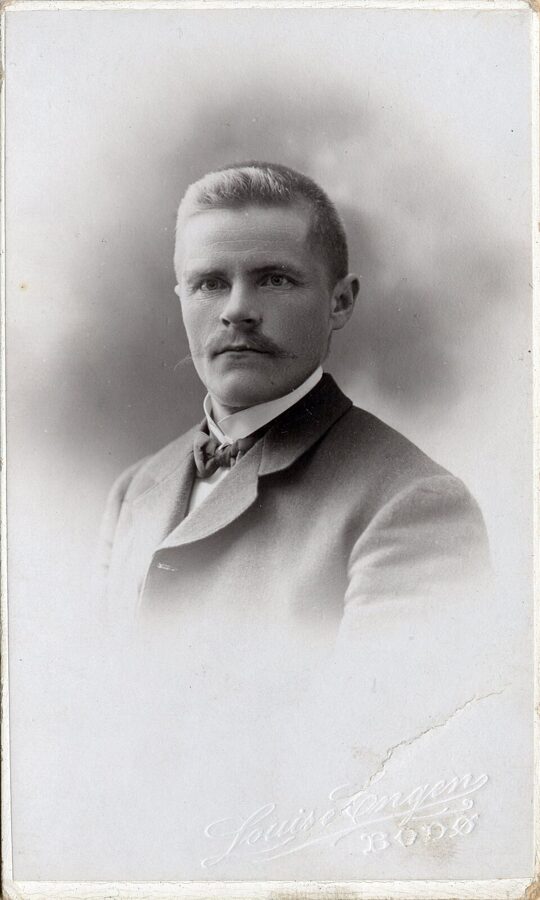
Kåven, asking her parents’ generation, found the stállu stories tied to the winter solstice rather than the Christian feast. Vars told NRK that nearly every figure in Sámi mythology worked as a threat in reserve for parents: the draug lived in the river so that children would not go to the water alone. Christmas Eve, dark early and full of busy adults, was one more place to keep them out of.
Much of the tradition has fallen away. Vars kept the tidying for her own children and dropped the part about the painful death.
Before the church: gifts for the midwinter powers
What Sámi did at midwinter before Christianity is known only in patches. Store norske leksikon’s article on Sámi religion is clear that the source base is thin and has to be read critically. Much of what survives was written by missionaries who wanted to stamp the religion out, and some of it is invention: the priest Johan Randulf described Sámi catching, killing and roasting small devils, which was never a Sámi practice.
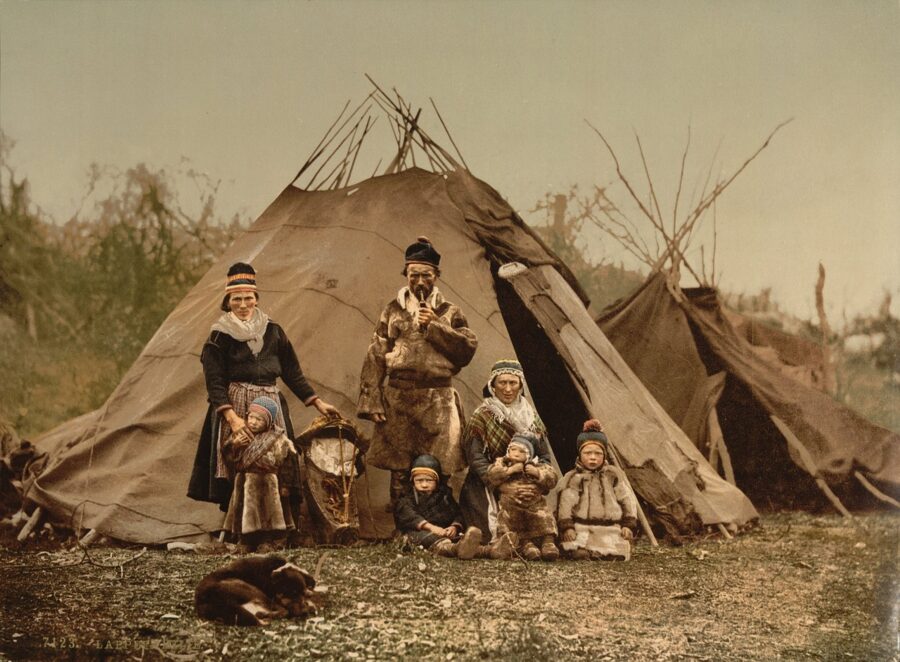
With that caveat, Reaidu gives a sketch. In the pre-Christian period people made offerings at what is now Christmas time to several powers, among them Bieggolmmái, the wind man, and Sáráhkká, the mother of creation who lived by the hearth. A figure called Juovlahearra, the “Christmas lord”, a word borrowed from Norwegian, also received offerings. In some places people offered reindeer blood and spirits; in others they put Christmas food into small birch-bark boats and placed them high in the trees.
Some researchers, Reaidu notes, see these customs as close to the old Norse midwinter feast, the product of neighbours living side by side. On the Norwegian side, lights were left burning and food left out on Christmas night, customs some scholars link to the dead coming home in the darkest part of winter. Both peoples treated midwinter as a time when the house had to be ready for visitors from outside the ordinary world.
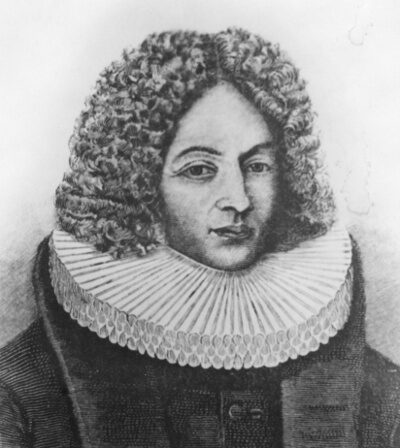
The organised mission put an end to most of this. From 1716 the Danish-Norwegian state sent Thomas von Westen and, by 1814, more than 130 missionaries into the Sámi areas. Church attendance became compulsory, people who kept the old practices could be prosecuted, and the drums were collected and burned.
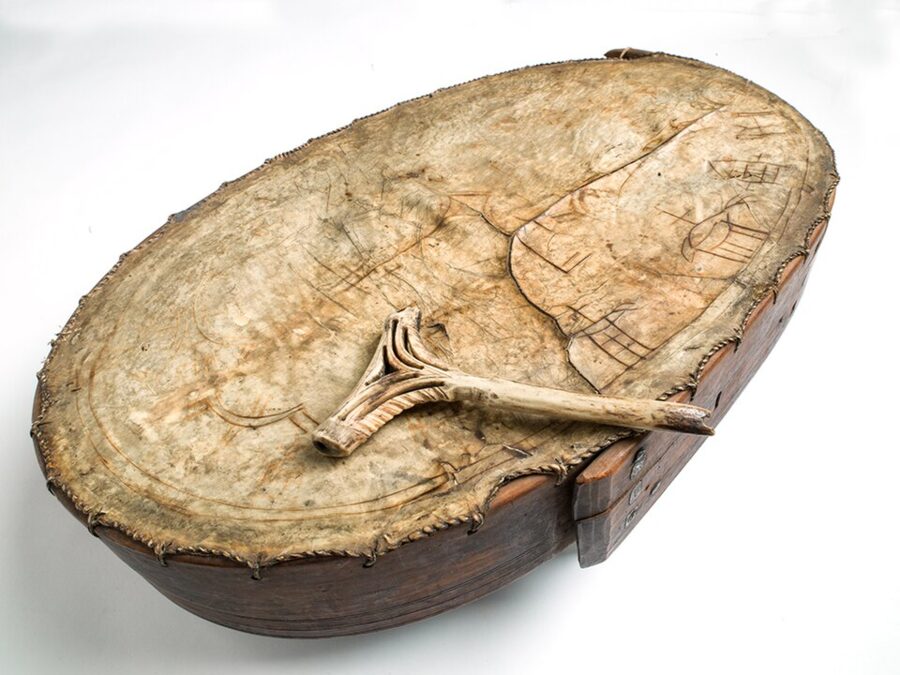
About 80 of the old drums survive, most of them in museums. One, Poala-Ánde’s drum, came back from Copenhagen to RiddoDuottarMuseat in Karasjok in January 2022. Some customs outlasted the drums, often side by side with Christian faith, and the stories of the dark season were among them.

Læstadius and the plain Christmas
The Christianity that shaped Sámi Christmas most in the far north arrived later, and from inside. Lars Levi Læstadius, born in 1800 with Sámi ancestry on both sides, was parish priest of Karesuando in Swedish Lapland from 1826 to 1849. When he arrived the parish had about 700 people, roughly 500 of them nomadic Sámi, and he set himself against drink.
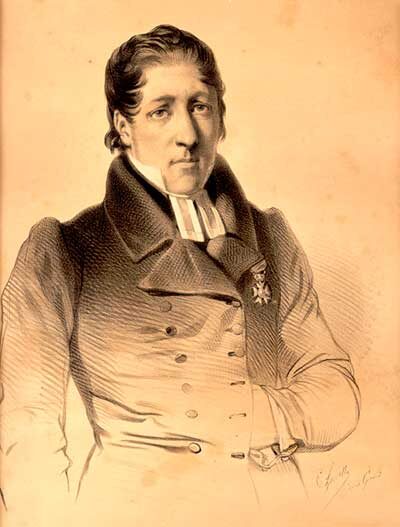
The turn came in early January 1844 at Åsele, on a visitation journey. There a young Sámi woman, Milla Clementsdotter, whom he called Maria, told him about her own path to faith, and he wrote later that through her he first saw “the way that leads to life”. His preaching changed: blunter, more personal, built on sin and forgiveness. A revival followed in Karesuando and then far beyond it.

According to Store norske leksikon on the Læstadians, the movement reached Norway in the late 1840s, at the same time in Kautokeino, Alta, Lyngen and Ibestad. In Kautokeino it took a fanatical turn that ended in the uprising of 8 November 1852, when the merchant and the sheriff were killed. Elsewhere it settled into a strict Lutheran piety with its own meetings, lay preachers and rules against alcohol, smoking and dancing.
Nobody keeps a register of Læstadians. In the late 1990s there were thought to be about 50,000 in Norway, and fewer today. The movement spread across Finnmark and into inner and northern Troms, but it is neither exclusively Sámi nor something all Sámi follow.
No tree, no star, no joik
For Christmas this meant plainness. Reaidu notes that in the Læstadian tradition the birth of Jesus is the whole point of the feast, and some symbols other families treat as essential count as idolatry: the Christmas tree and the Christmas star in particular. Many Læstadian homes have neither, and decorate with flowers and Christmas ribbons instead.
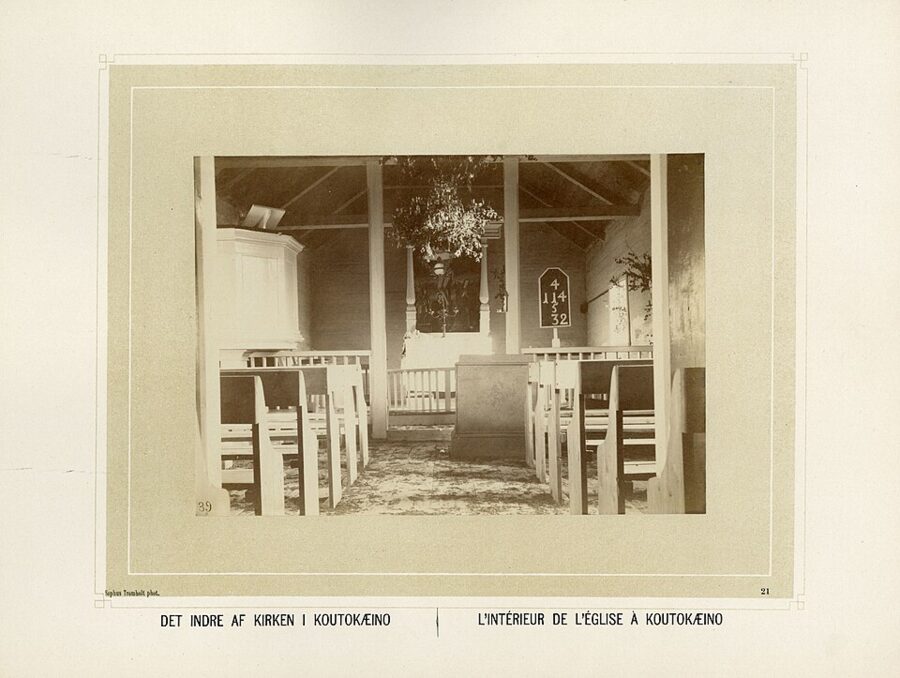
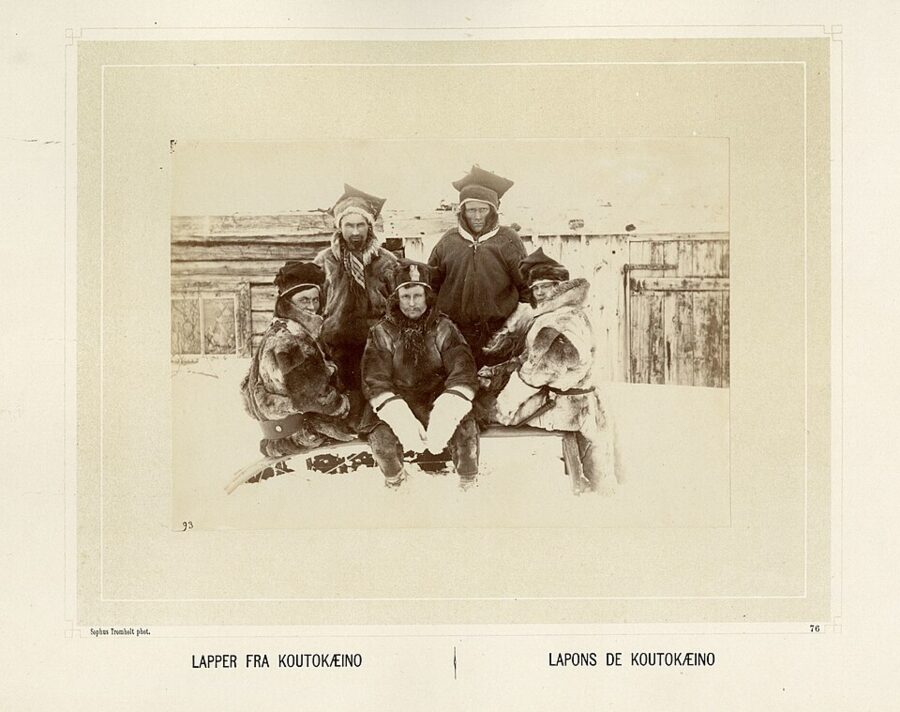
The plainness reached clothing too. Store norske leksikon’s article on Sámi dress notes that Læstadianism held that people should not dress in strong colours or decorate themselves too much, which may have toned down gákti colours in Finnmark, Troms and around Karesuando in the late 19th and early 20th centuries. Joik, the Sámi song form, is still a sore point in church. When the trumpeter Ole Edvard Antonsen joiked during a concert in Kautokeino Church in October 2013, the parish council closed the church to concerts.
The Christmas services matter more than anything at home. A Firstborn Laestadian family in southern Finland described their Christmas to Yle in 2016: no Father Christmas and no television, a short family devotion with the Christmas gospel, and on Christmas Day the international Christmas meetings broadcast from Gällivare in Swedish Lapland, which last five days. Gällivare is the central gathering place for the Firstborn, the Læstadian branch also found in Finnmark, Troms and Nordland.
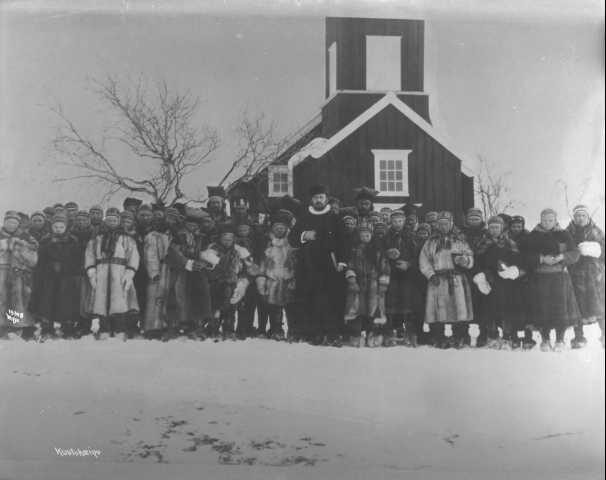
Christmas Eve in Kautokeino and Karasjok
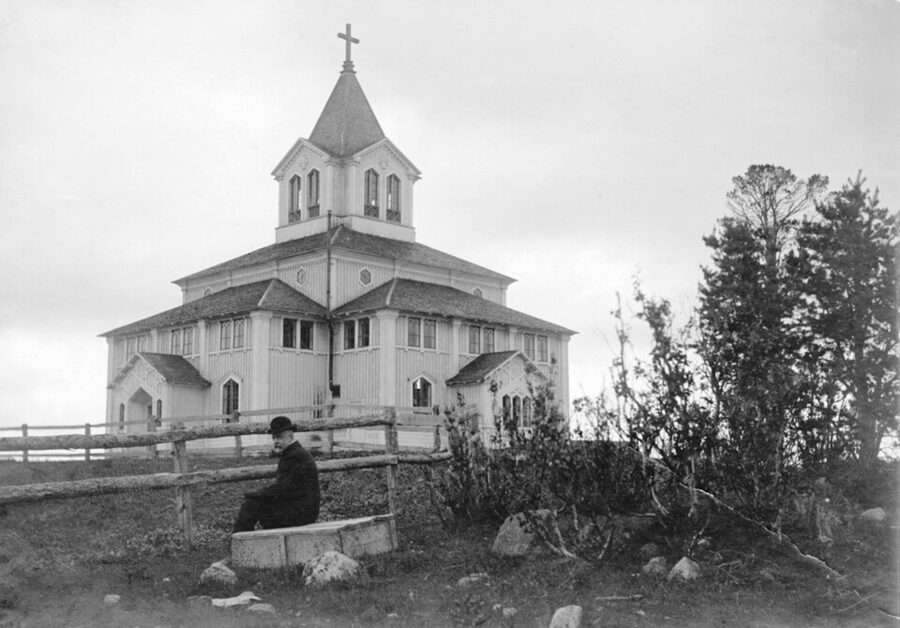
Kautokeino and Karasjok, the two Sámi-majority municipalities on Finnmarksvidda, are where an outsider sees Sámi Christmas most clearly, mostly in church. Both were burned in the German retreat of autumn 1944, so almost everything in them is post-war.
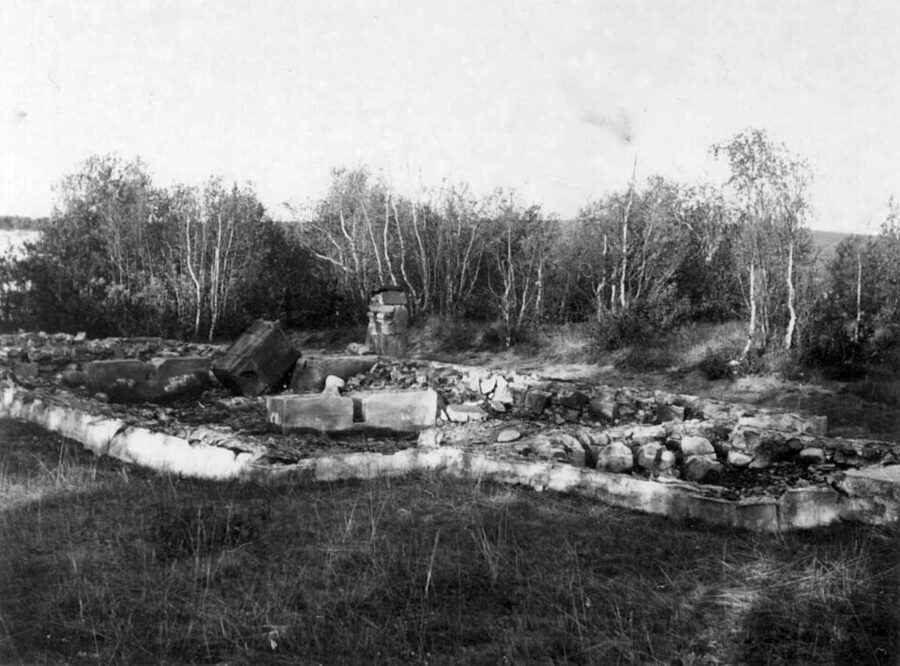

Kautokeino
Kautokeino Church was finished in 1958 on the east side of the Kautokeino river, south of the centre: a red, wooden long church with about 300 seats and an altarpiece by Jørgen Mudd showing Christ as a shepherd.
The parish’s listing for the 2026 Christmas Eve service puts it on Thursday 24 December at 14:00. Some people come in gákti; dressed-up Kautokeino style means large silver brooches, and a child usually gets a proper one for confirmation.
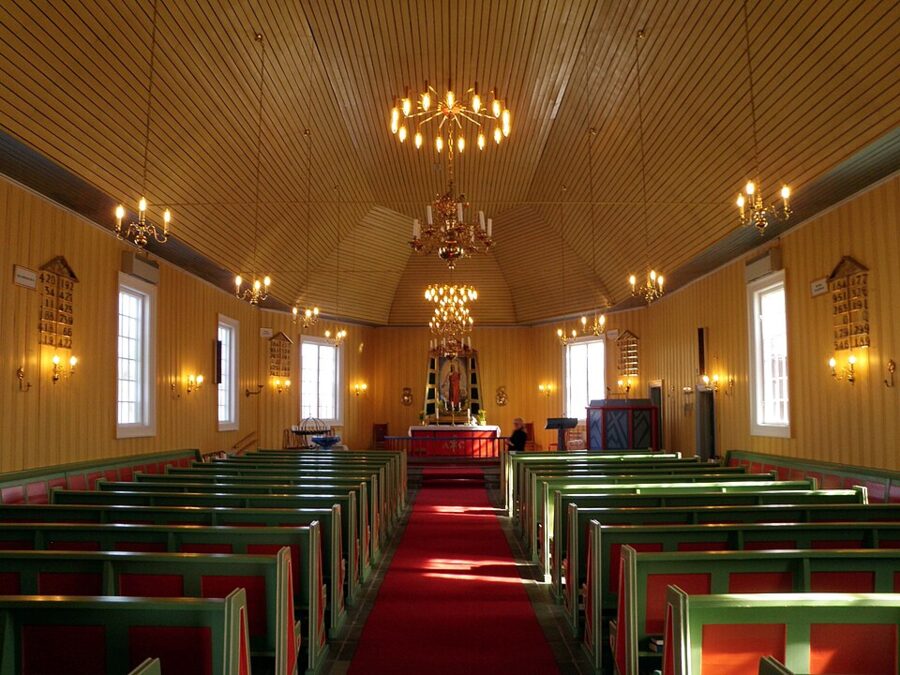

Christmas in Kautokeino is quiet by the town’s own standards. The big public gathering of the year is the Easter festival, with its reindeer racing; Christmas belongs to the family and the church, and the herd still needs watching.
Karasjok
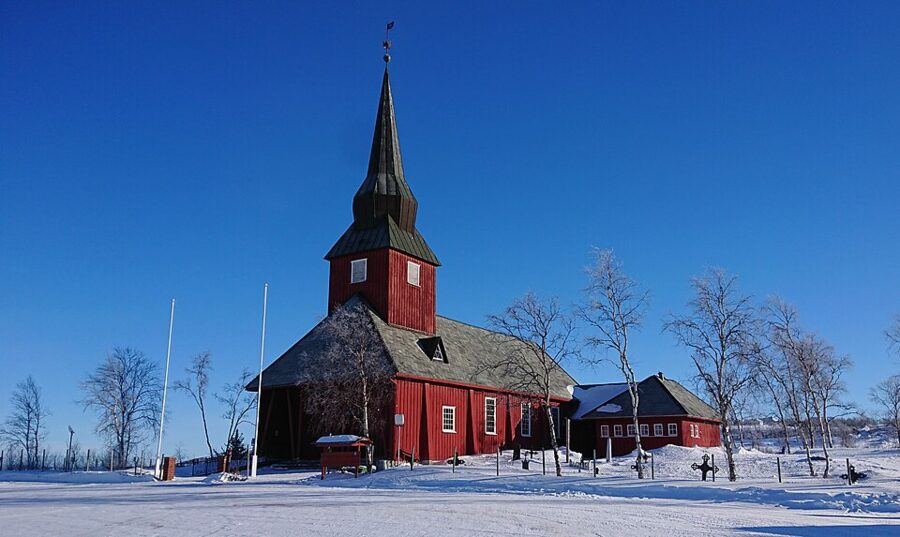
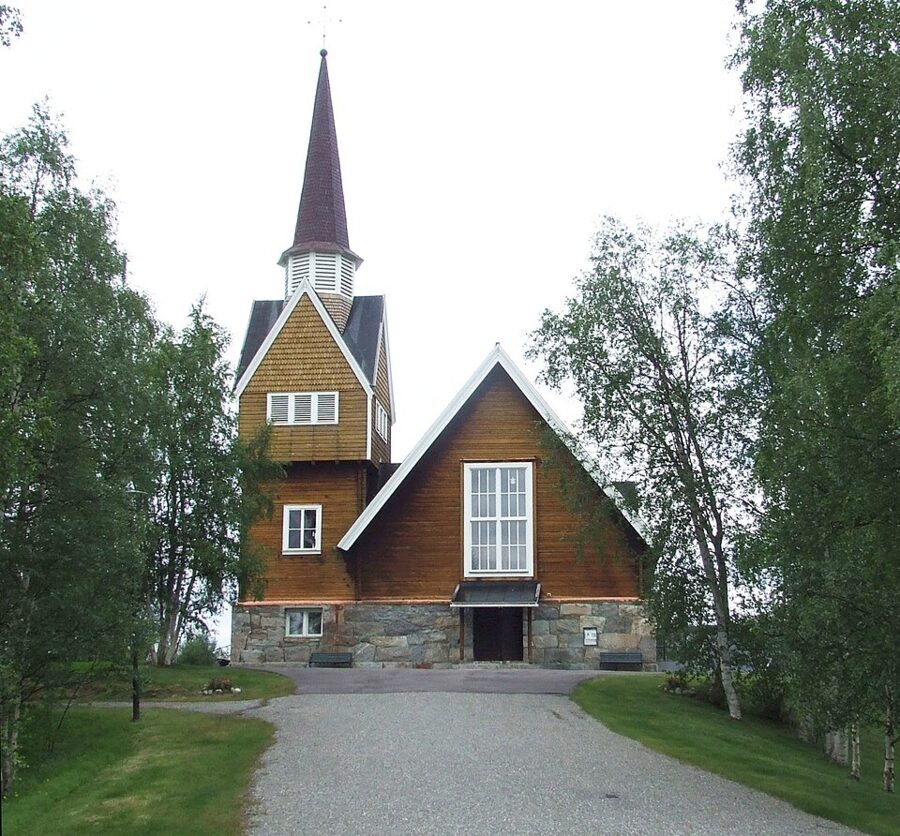
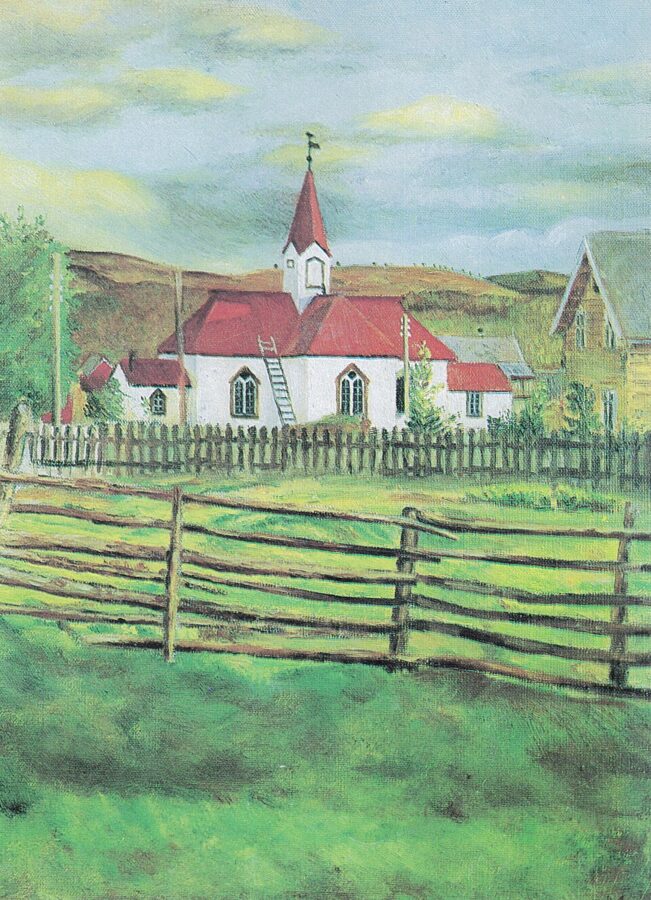
Karasjok has two churches. The old church of 1807, a cross-shaped timber building on a bend of the Kárášjohka river, is the oldest church building in Finnmark and one of the few in the town left standing when the Germans burned it in 1944. In 1945 it served for a time as a field hospital and shelter. A carved arch over the choir door has reindeer on it, beside the monogram of King Christian VII.
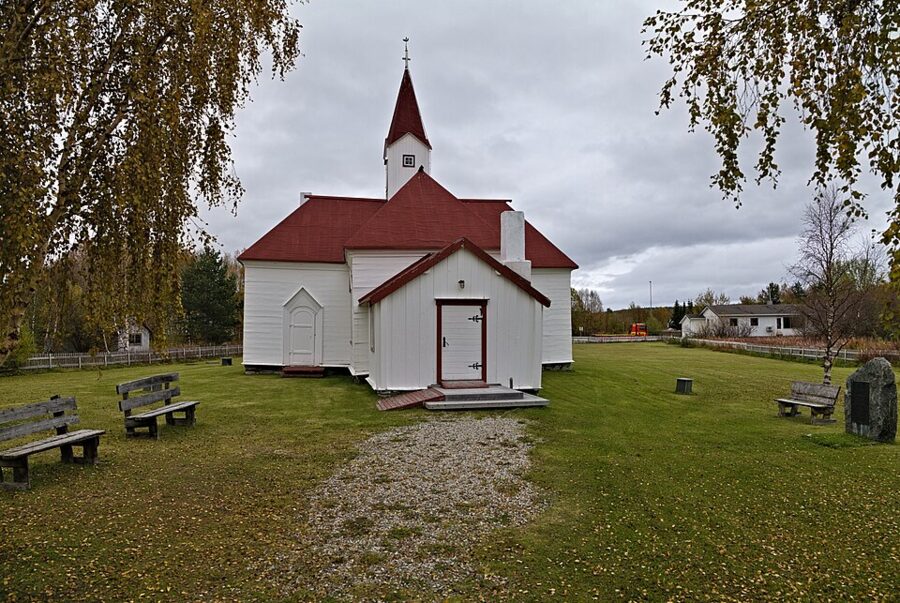
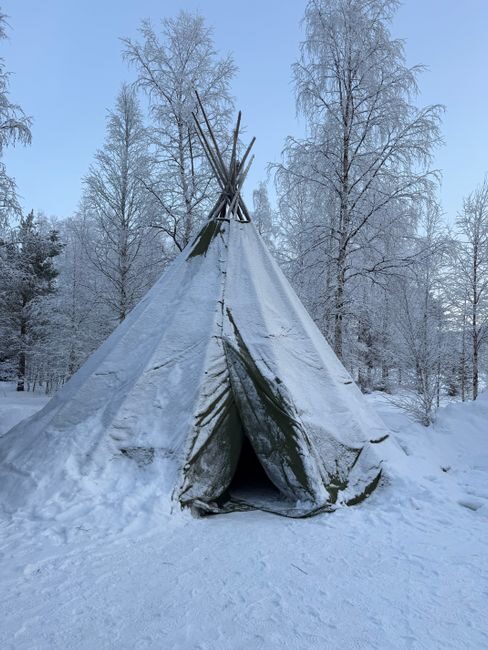
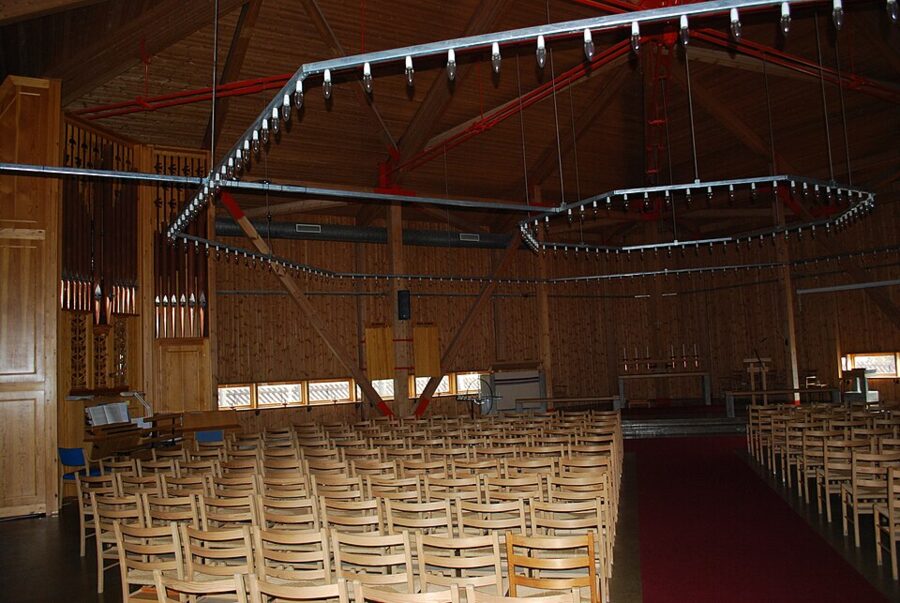
Karasjok Church, built in 1974, replaced it because the old church had only 140 seats in a municipality of nearly 3,000 people. The architects took the turf hut, the gamme, as their model: a dark wooden building with a square plan and a low pyramid roof. The pulpit is extra wide because services are often interpreted between North Sámi and Norwegian, the altar cross is carved from reindeer antler, and the figure of the risen Christ is by Nils Persen Magga from Nesseby.
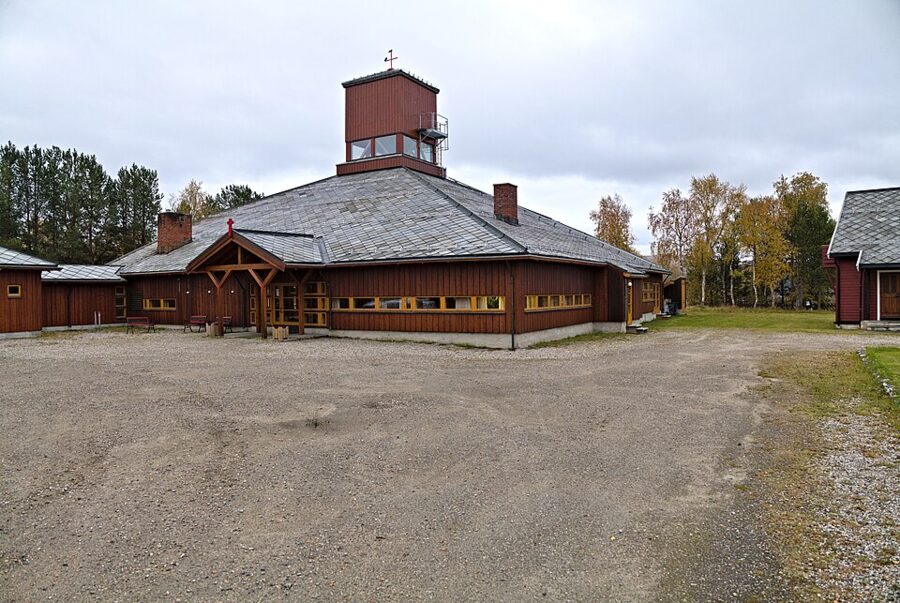
The Christmas Eve service at Karasjok Church is listed for Thursday 24 December 2026 from 15:00 to 16:00, as juovlaipmilbálvalus, the Christmas service. The parish lists a New Year’s Eve service, ođđajagiruohtaipmilbálvalus, at 17:00 on 31 December.

Sámi Christmas in song
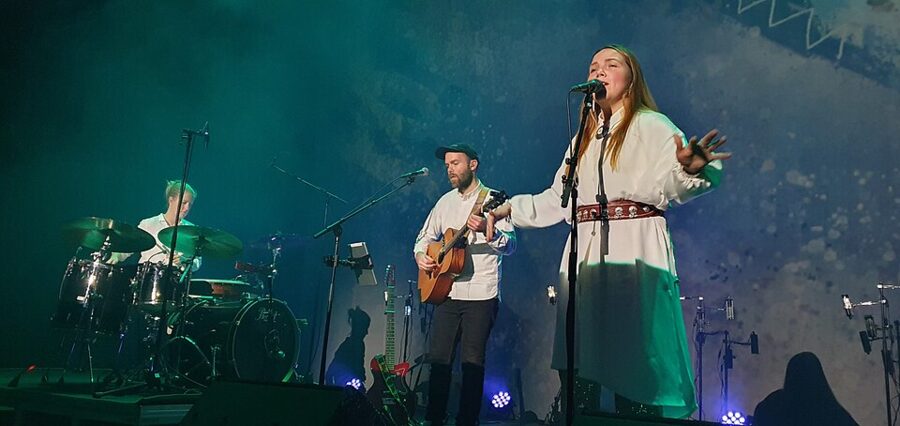
Sámi Christmas music has grown from a handful of hymns into a small repertoire. In 1987 Mari Boine recorded Juovllaide, a cassette of Christmas songs in Sámi, with the young singers then known as Aŋŋel nuorat, in Lakselv. The singer Kajsa Balto released her Christmas album Sámi juovllat in 2021, mixing translated carols with joik-inspired new songs in North Sámi.


In 2023 Balto told NRK that Norwegians hear Christmas music in Spanish, French and English, “but I don’t think anyone knows ‘Glade jul’ in Sámi”. On 1 December 2024 she and the Norwegian Radio Orchestra gave the first Sámi Christmas concert at the Oslo Opera, and in November 2025 Folkebladet reported she had sold out the Opera with a Sámi Christmas concert for the second time. In Oslo, the Sámi Christmas market had by 2022 become, in NRK Sápmi’s words, a tradition and a place to speak Sámi.

Reaidu points to one more tradition, from Olmmáivággi (Manndalen) in Kåfjord, Troms: ođđabeaigállát, a New Year’s Eve procession in home-made masks of skin, wool and bone, meant to frighten off evil spirits. It has run at least since the early 1900s and is found only in that valley. In Nord-Troms, people dressing up and going door to door at Christmas ask if “Daban” is at home.
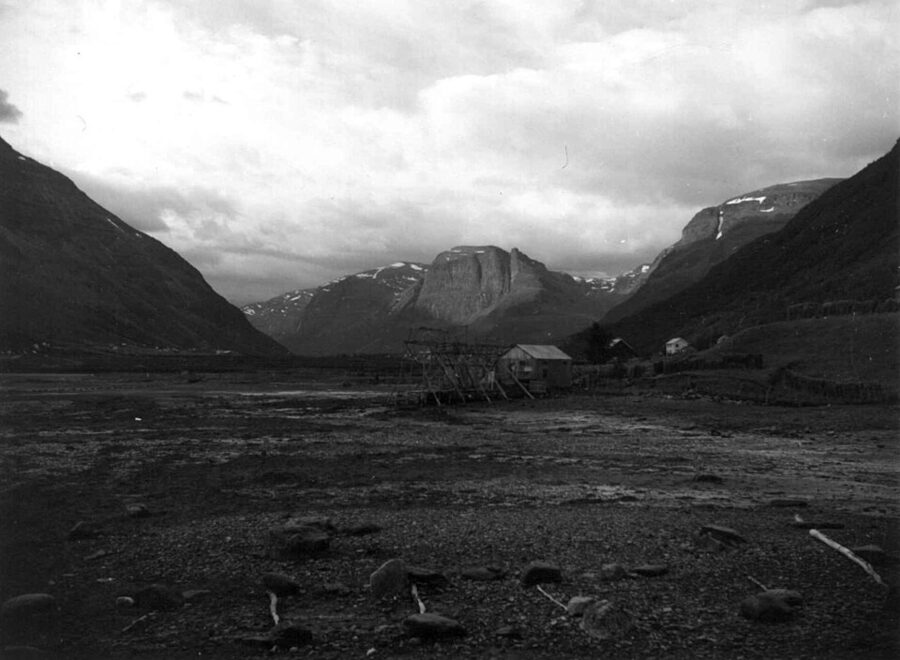

Reindeer, trout and biđos: the Christmas table
The old Sámi Christmas meal was ordinary food made a little better. Anni Äärelä, who grew up in a reindeer-herding family at Nunnanen in Enontekiö, told Yle Sápmi in 2017 that before the war nothing unusual was eaten at Christmas: sautéed reindeer and meat soup. “We didn’t know anything about pork.” The first shop near her home opened in the mid-1950s, 13 kilometres away, and her mother came back with rice for the first rice porridge she had ever tasted.
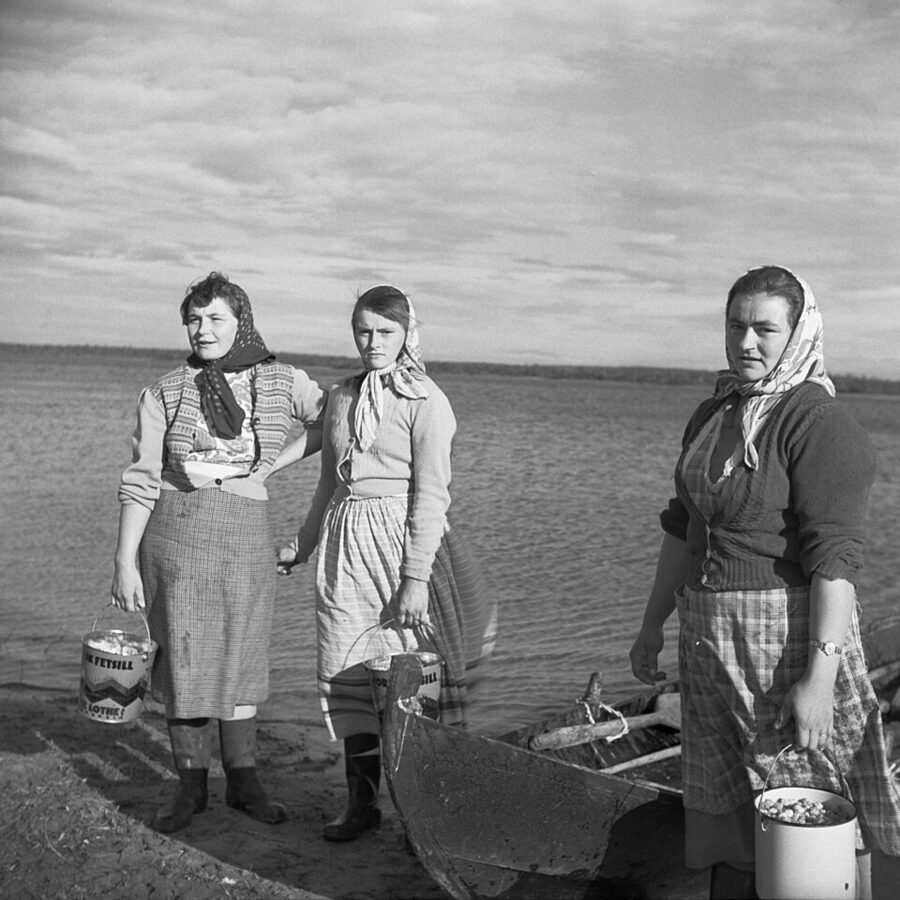

In the same report, the Inari Sámi chef Heikki Nikula described the Inari Sámi Christmas as the time the best went on the table. The biggest and fattest trout caught in autumn was salted and kept for Christmas, reindeer roast was cut thin and sautéed, and there were rarer things, such as cheese made from reindeer milk. In his own family the trout came from the Juutuanjoki river, and reindeer roast was served on St Stephen’s Day, 26 December.

In North Sámi homes the Christmas food is very often reindeer. The festive dish in Norway is biđos, a reindeer stew made on a broth boiled from meat and bones, with carrot, onion and potato, and lingonberry jam on the side. Before potatoes spread in the late 1700s it was eaten with bread. It is festival food more than Christmas food in particular, the dish of weddings, confirmations and 6 February.
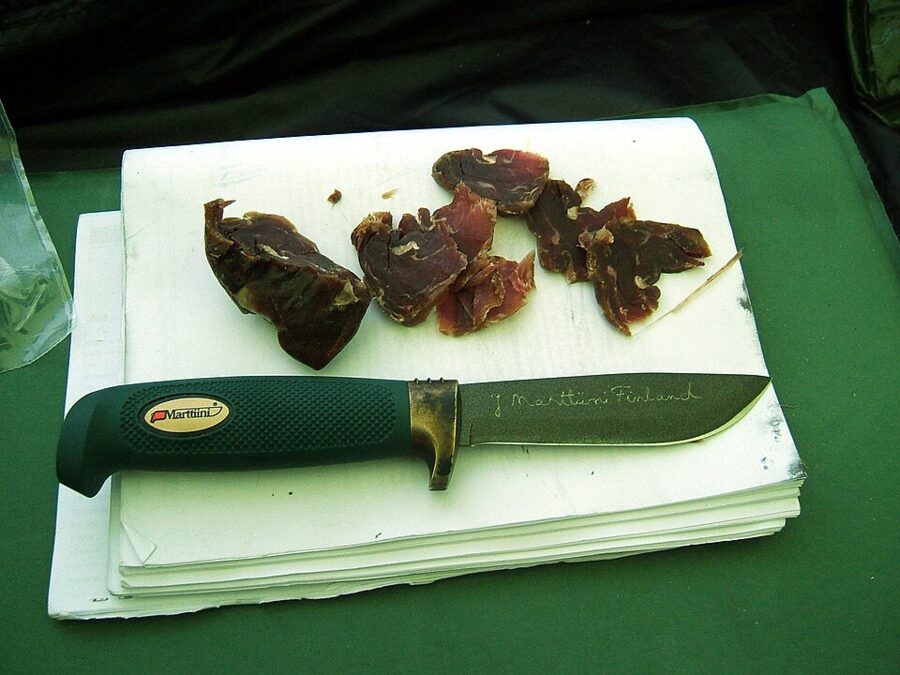

Today the table is mixed. Finnish Sámi homes now have the ham and baked casseroles of a Finnish Christmas alongside the reindeer, and Äärelä told Yle she still would not eat them: a sandwich and sautéed reindeer were enough for her. I would take her side. The reindeer is the better Christmas dinner.
December in the herd
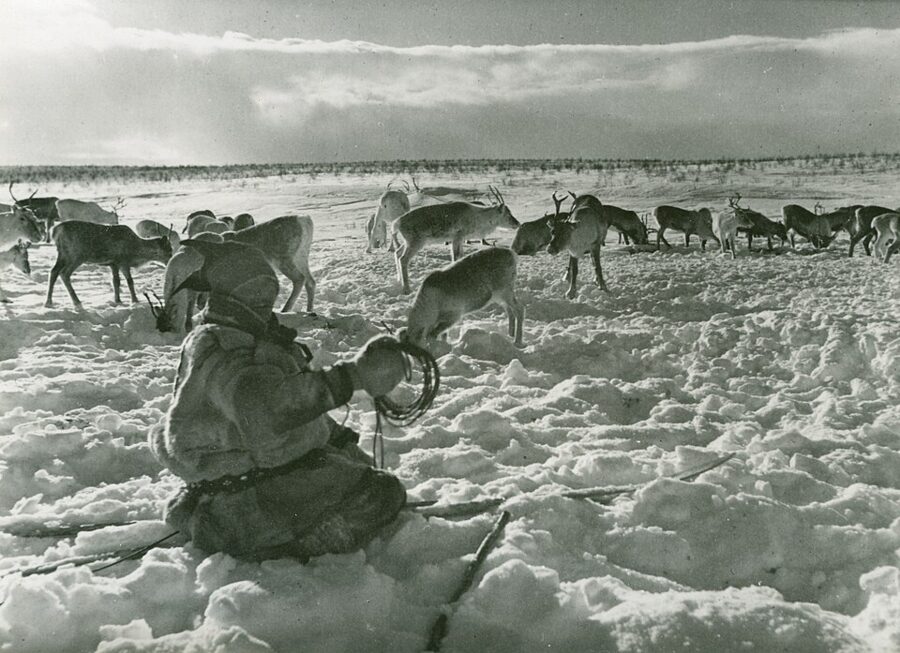
Reindeer do not stop for Christmas. In the herding calendar used by Norway’s Agriculture Directorate in its account of the herding year, autumn-winter begins in November and lasts through December, and winter begins in December and runs into March. Much of Finnmark’s herding is a long move from summer pastures on the coast and islands to winter pastures inland, around Kautokeino and Karasjok, where the snow is thinner and drier.
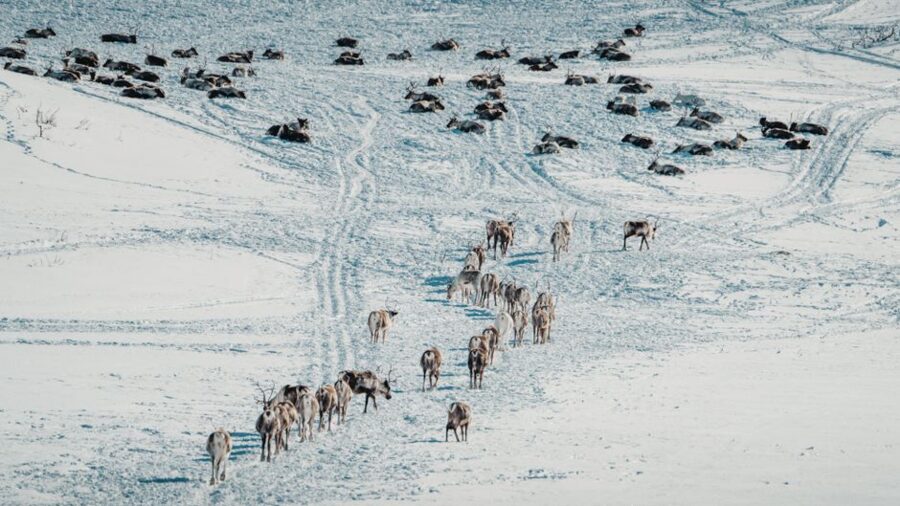
The directorate describes December as working time. After the snow has settled there is a second slaughter, and in November and December more of the animals taken are females; at the same time the herders choose which animals to keep and separate their reindeer from neighbouring herds. Early in the winter the animals graze easy pastures under a light, even snow cover, and where the grazing allows, the herd is held together in a small area and watched.
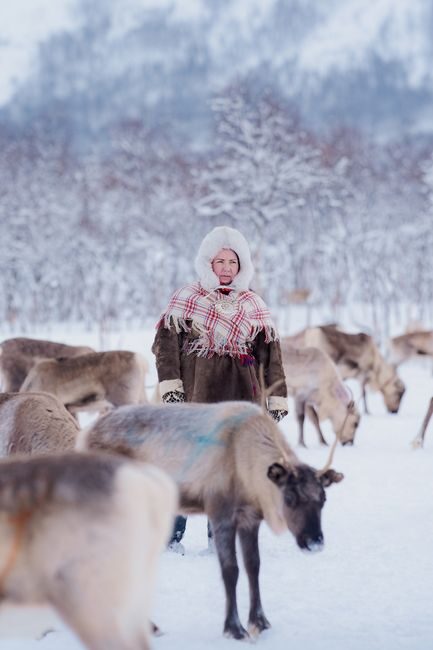
So in a herding family, Christmas can mean Christmas in shifts: someone stays with the reindeer while the rest go to church. And the pastures can fail. In the winter of 2024–25 thaw, rain and frost locked much of the grazing in Nordland, Troms and Finnmark under ice.

Where to meet Sámi midwinter culture in December and January
There is no Sámi Christmas festival to buy a ticket for, and I would be wary of anything sold as one. Go where Sámi midwinter life happens in public: the churches, the museums and the events of late January and early February. If you are basing yourself in Tromsø, Karasjok and Kautokeino are a long winter drive or a flight via Alta away, so when planning a trip to Norway in December, give the journey a full day each way.
Museums
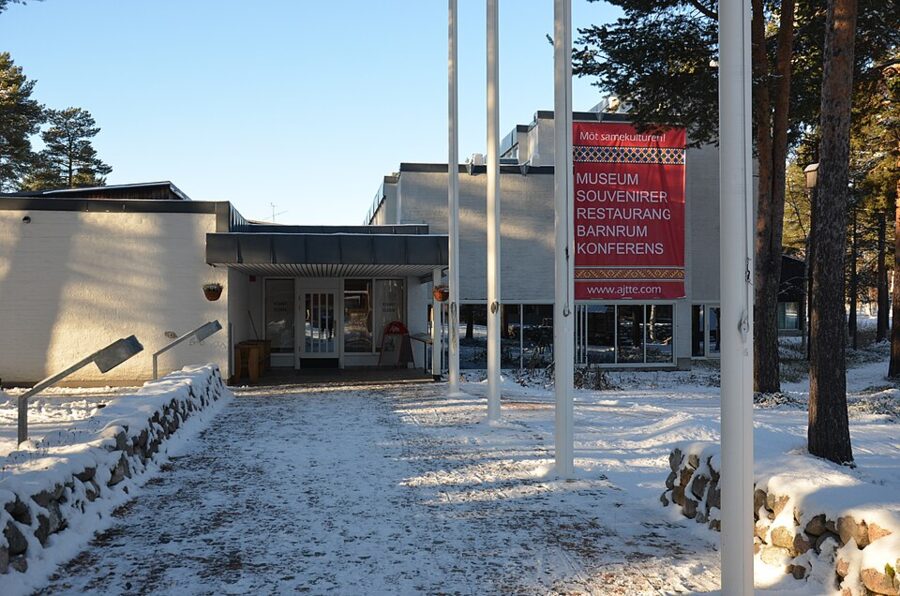
Ájtte, the Swedish mountain and Sámi museum in Jokkmokk, is open from mid-September to 31 December on Tuesday to Friday 10:00 to 16:00 and Saturday 12:00 to 16:00, closed 24 to 26 December and 31 December. Entry is SEK 120 and free for children up to 16 with an adult. Its yearly midwinter afternoon, “Jul, jul skrämmande jul” (Christmas, scary Christmas), sends families into the dark basement corridors to meet “the beings of midwinter”; in 2026 it ran on Saturday 28 November, 12:00 to 15:00, with a workshop for making a šiella, a protective amulet.

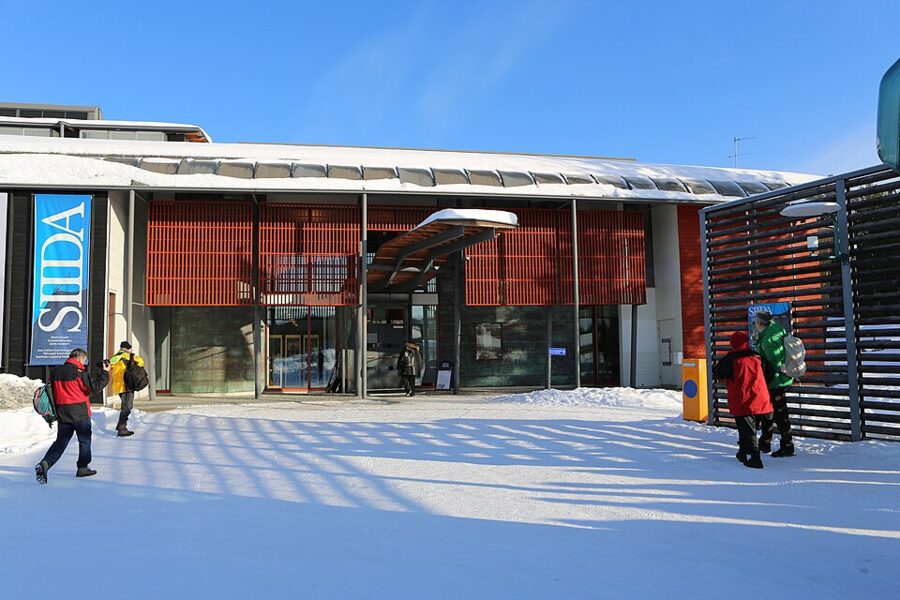
In Finland, Siida, the Sámi museum and nature centre in Inari, is open Monday to Saturday 10:00 to 17:00 in its winter season, from 5 October 2026 to 31 May 2027, and closed on Sundays. Over Christmas 2026 it opens 10:00 to 14:00 on 24 December and 12:00 to 17:00 on 25 December. Adult entry is €18. Inari is also one of the quieter bases for a cabin holiday in Finnish Lapland.

In Karasjok, check before you go. RiddoDuottarMuseat’s De Samiske Samlinger, founded in 1972 as the first Sámi cultural institution in Norway, has permanently closed the exhibitions in its main building while the collections are moved; the open-air museum remains. Ask the museum before planning a December day around it or the Kautokeino open-air museum.
Church services
The Christmas services are the most direct way to see Sámi Christmas, and they are public. Kautokeino’s is at 14:00 and Karasjok’s at 15:00 on Christmas Eve 2026. Come on time, sit at the back if you are unsure, and leave the camera in your pocket: this is a congregation at worship, not a performance. Everyday winter clothes are fine; the Kautokeino parish says as much on its Christmas in church page, and I would not turn up in an imitation gákti.
Skábmagovat, 6 February and Jokkmokk Market
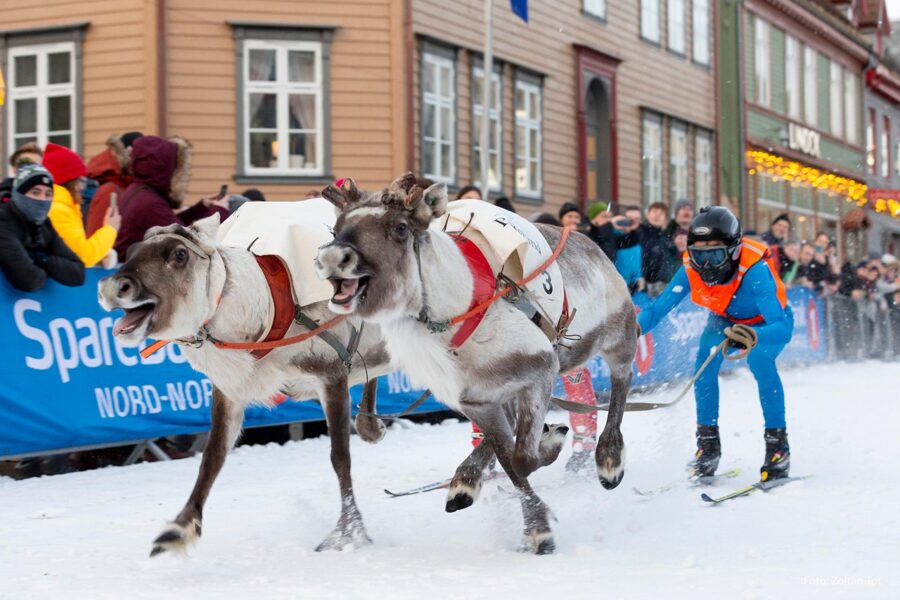
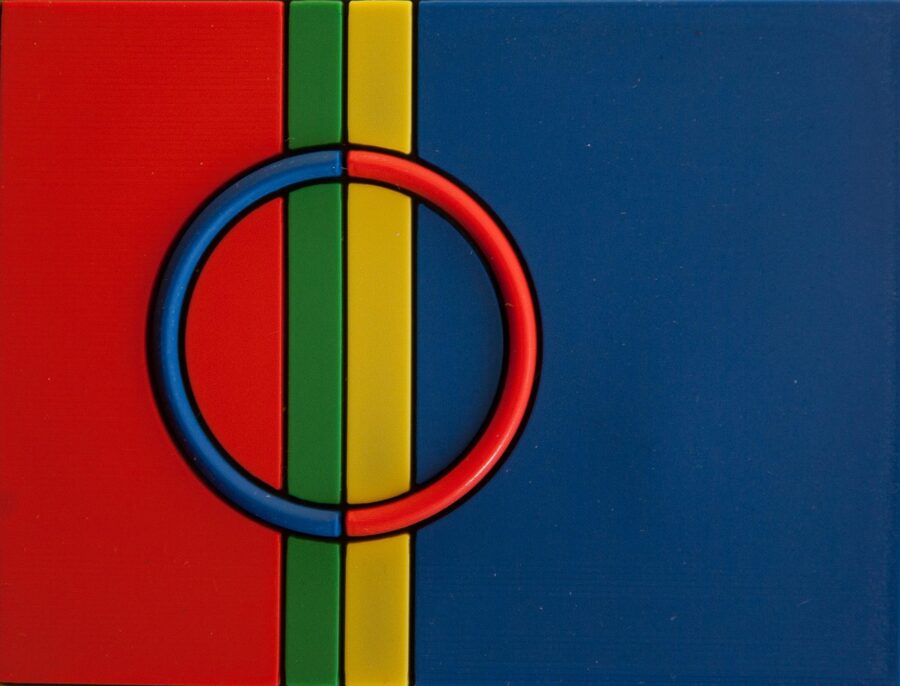
The midwinter calendar picks up after New Year. Skábmagovat, the Indigenous film festival in Inari, runs from 28 to 31 January 2027; its name puts skábma, the dark season, together with govat, pictures. 6 February is the Sámi National Day, marking the first Sámi national meeting in Trondheim in 1917, chosen in 1992 and an official flag day in Norway since 2003. In Tromsø it falls inside Sámi Week, which includes the Norwegian championship in reindeer racing on the snow of the main street.
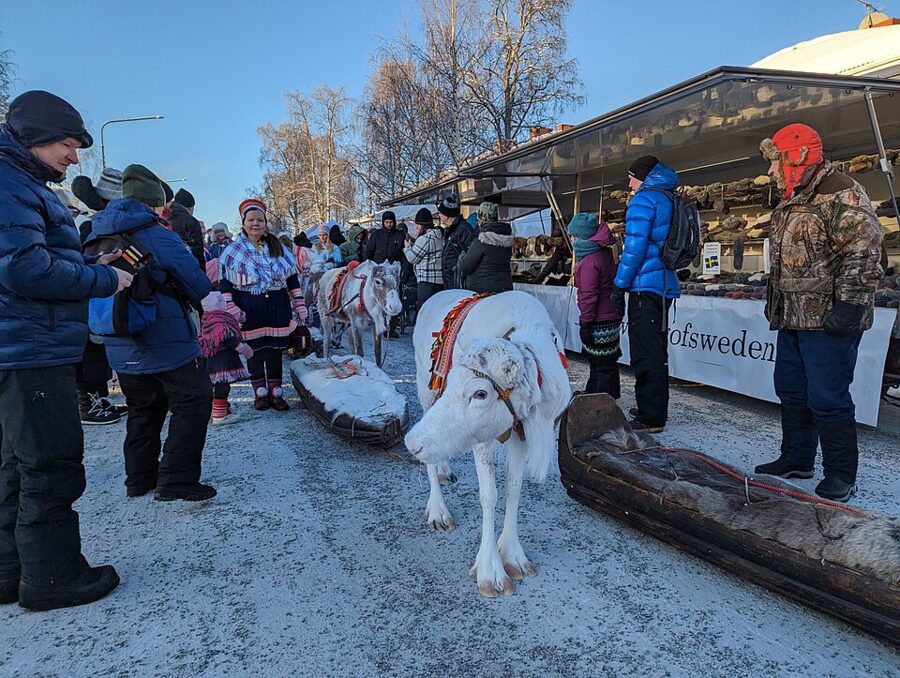
Jokkmokk Market in 2027 is the 422nd, from Thursday 4 to Saturday 6 February, with the market area open 10:00 to 18:00 and events through the week. Programmes usually appear in December, and the reindeer caravan through town is the picture everyone takes home.

What not to do
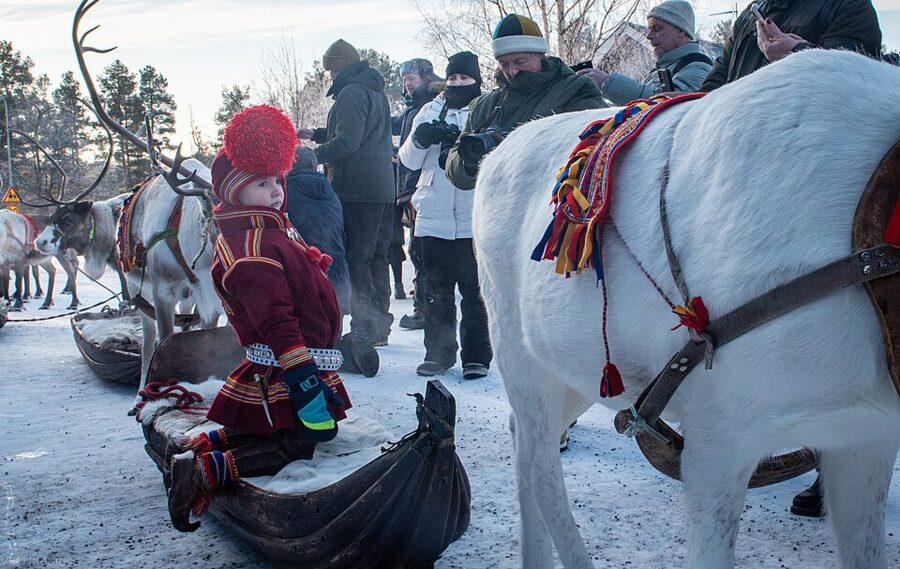
Visit Norway’s advice on travelling with respect in Sápmi starts with photographs: always ask before you take one of a person. In December that applies with extra force to people in gákti on their way to church, and to herders at work. Keep your distance from reindeer on the roads and on the plateau; they are not tame, and a herd run off its pasture in an icy winter is a real loss to someone.
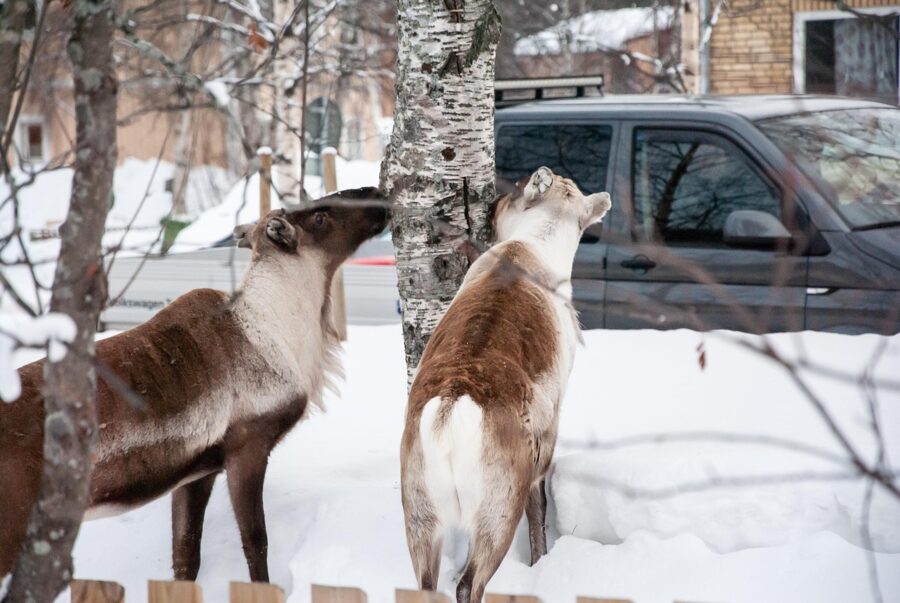
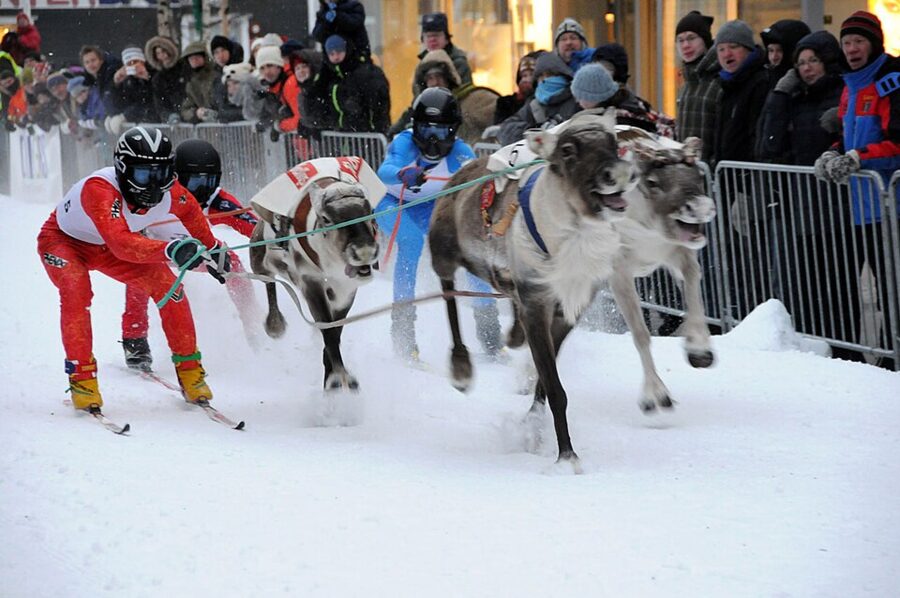

Do not buy a “Sámi” souvenir without asking who made it, and be wary of reindeer outings presented as Sámi culture by people who are not Sámi; ask the same questions as for any Arctic animal tourism: whose animals, whose land, whose story. And if you are staying with a Sámi family over Christmas, take the hint about noise on Christmas Eve. Nobody believes in juovlastállu any more, and almost everyone still tidies the yard.
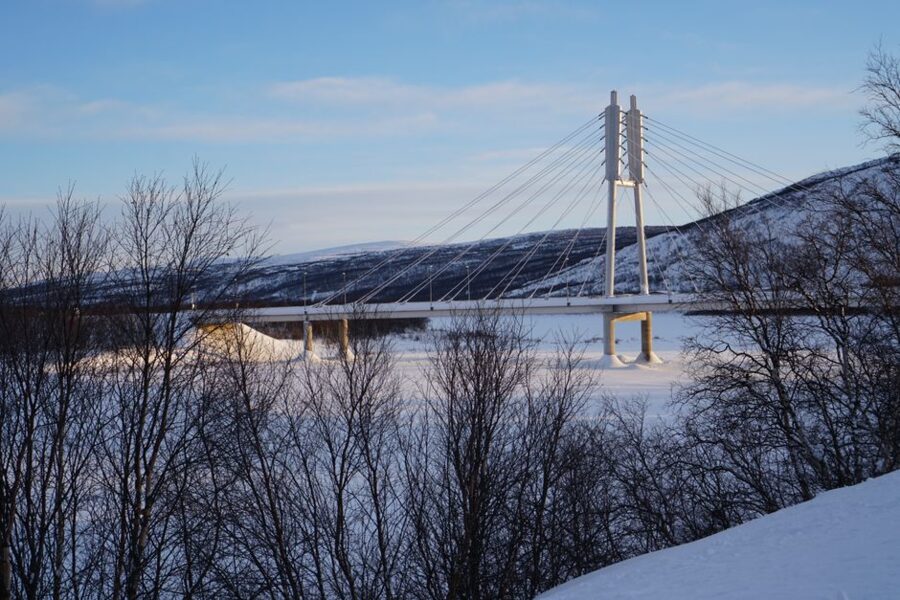
If you are in Karasjok on 24 December 2026, the sun will not have risen for nearly four weeks. The service at Karasjok Church starts at 15:00, in a church built to look like a turf hut, under two rings of light. Walk back afterwards through a yard someone has cleared, and if there is a cup of water by a door, leave it where it is.